
A child can eat a day that looks like four crackers, half a yogurt pouch, and not much else — and suddenly the vitamin aisle starts looking very persuasive.
Most searches end the same way: ten products, very little explanation of why, and almost no attention to the fact that the “best” vitamin is useless if the form never gets taken. So I compared more than 30 kids multivitamins — reading labels, cross-referencing certification status on the USP and NSF databases, comparing nutrient forms, and eliminating anything with a proprietary blend that didn’t disclose amounts. Here’s what stood out, including a form most articles barely mention.
To compare products fairly, I looked at nutrient forms (D3 vs D2, methylfolate vs folic acid), sugar content, iron inclusion, named third-party certifications, and how practical each form actually is for real families. I excluded anything with unclear labeling or undisclosed proprietary blends. If a “best multivitamin for kids” list doesn’t show you that work, it’s just a ranking.
This page contains affiliate links and may include sponsored content. As an Amazon Associate, I earn from qualifying purchases at no extra cost to you. Amazon links are labeled #ad; other affiliate links may be marked as “affiliate link,” “Sponsored,” or “(paid link).” Affiliate Disclosure.
Table of Contents
- Does My Kid Actually Need a Multivitamin?
- What I Learned About Form: Gummies, Chewables, Liquids — and the One Nobody Talks About
- What to Look for on a Kids Vitamin Label
- The Comparison Table: Top Picks at a Glance
- Best Vitamins for Kids: What I’d Actually Buy and Why
- Find the Right Vitamin for Your Kid
- If Your Kid Refuses Everything: A Form-by-Form Guide
- Frequently Asked Questions
For more on what kids actually need nutritionally day-to-day, my family nutrition guide for kids covers the full picture — omega-3s, iron, brain foods, and what the research actually says.
Does My Kid Actually Need a Multivitamin?
The American Academy of Pediatrics says that most healthy children who eat a reasonably varied diet don’t need a daily multivitamin. That’s the honest answer, and I’m not going to bury it.
But “reasonably varied” is doing a lot of work in that sentence. Kids with severely restricted diets or prolonged picky eating can have real nutrient gaps, but which nutrients matter depends on age, diet, feeding pattern, medical history, and sometimes laboratory testing. Vitamin D and iron are two nutrients clinicians commonly pay attention to; that does not mean every picky eater needs a broad multivitamin.
So: if your child eats a genuinely wide range of foods, a routine multivitamin may add very little. If the current diet could fairly be described as “beige and beige-adjacent,” the question becomes whether there is a real nutritional gap worth addressing. I would use a multivitamin as gap insurance, not as a substitute for figuring out what the diet is actually missing.
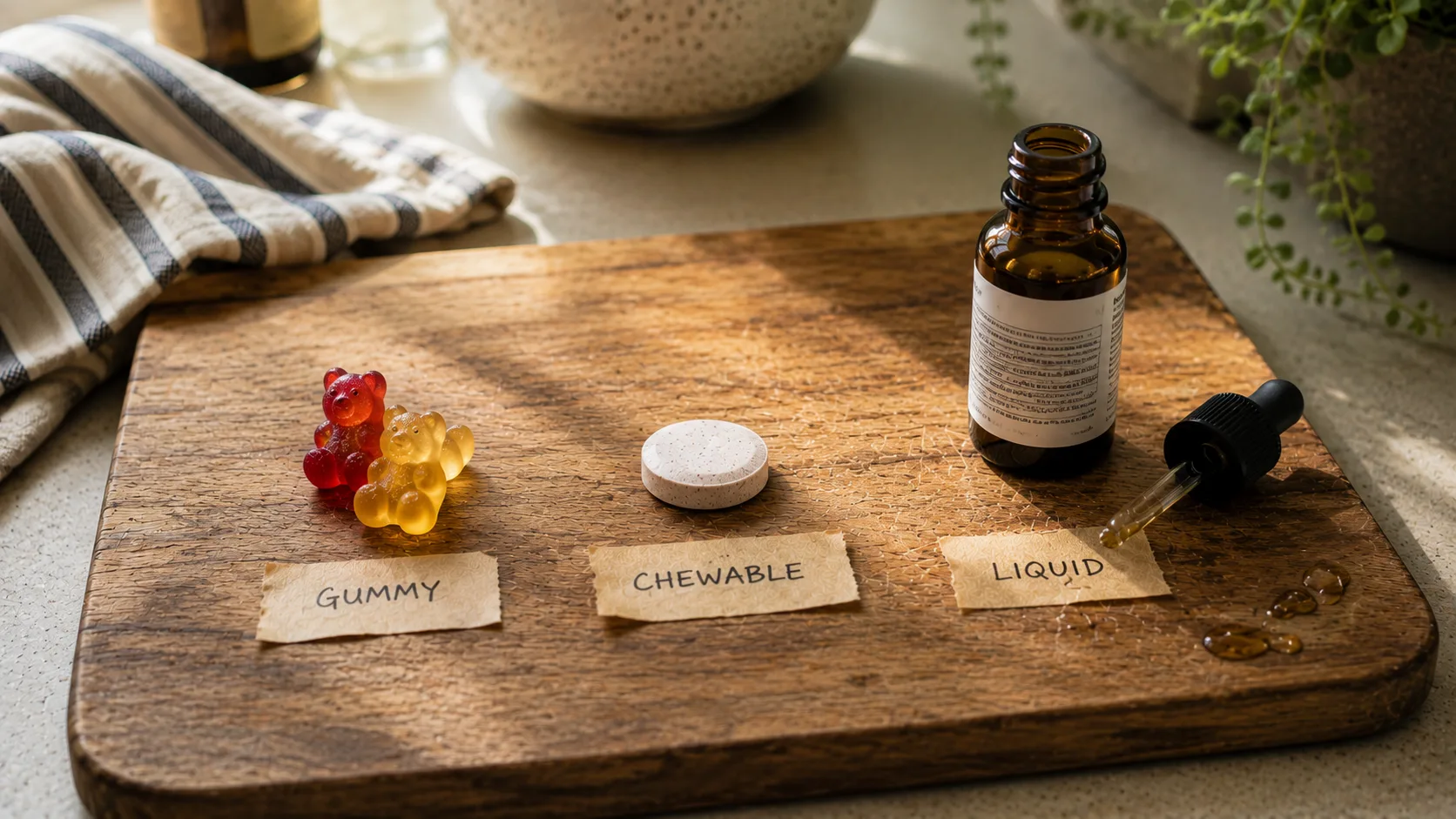
What I Learned About Form: Gummies, Chewables, Liquids — and the One Nobody Talks About
This is where most vitamin roundups lose me. They either ignore the form question or give a vague “gummies are popular but chewables may be better” without explaining why. Here’s what the research actually shows and what matters in practice.
Gummy vitamins
The most popular form, and the most complicated. Gummies are designed to be palatable, which can make the format appealing — but acceptance is individual. But there are real trade-offs. Most gummies can’t include iron (it reacts with gummy ingredients and tastes metallic), they typically contain 2–5g of added sugar per serving, and gummy format doesn’t hold certain nutrient doses as well as tablet or liquid forms. The sugar issue is real if your kid already eats a high-sugar diet, since a gummy vitamin can contribute meaningfully to their daily total.
Chewable tablets
Can include iron, usually lower in sugar than gummies, and hold a more complete nutrient profile. Absorption is generally comparable to gummies for fat-soluble vitamins, though the lack of added sugar means your kid isn’t getting a small candy alongside their D3. The trade-off is taste. Chewables can have a more concentrated vitamin taste than gummies, so texture and flavor are the main trade-offs for a taste-sensitive child.
Liquids
Easiest to adjust dose, good for very young kids or those who can’t chew yet. Downside: strong taste, and some kids hate the texture. They work better mixed into a smoothie or juice.
Melty tabs and dissolvable strips
Melty tabs (like Renzo’s) remove two practical barriers at once: no gummy texture and no tablet to swallow. That makes the format worth comparing when chewing or swallowing is the sticking point. Taste still matters, and I would not promise that one form automatically solves refusal.
What to Look for on a Kids Vitamin Label
Before I get to specific picks, here’s the framework I used. Pull this up in-store if you’re comparing brands on the fly.
| What to check | What you want to see | Red flag |
|---|---|---|
| Vitamin D form | D2 or D3 at an age-appropriate amount; D3 may raise blood vitamin-D levels somewhat higher and for longer | Megadose marketing or a dose that does not fit the child’s age/intake |
| Folate form | Folic acid or 5-MTHF can both be legitimate supplement forms at an appropriate amount | Marketing that treats a common MTHFR variant as proof a child cannot use folic acid |
| B12 form | Cyanocobalamin, methylcobalamin, or another established B12 form at an appropriate amount | Claims that one common supplemental B12 form is automatically “more bioavailable” or clinically superior |
| Iron | Included only when there is a real reason for iron and the amount fits the child’s age/need | Adding iron “just in case,” especially when deficiency has not been assessed |
| Sugar content | Under 2g per serving ideally; 3g acceptable | 4g+ per serving adds up fast in a gummy |
| Third-party verification | Named testing/certification that matches what it actually certifies | No named certifier on label |
| Fat-soluble vitamins (A, D, E, K) | Doses within age-appropriate ranges — these accumulate in the body | Very high % DV for vitamin A specifically |
| Artificial dyes | Check the ingredient list if avoiding artificial colors is a household or clinician-guided preference | Using “no artificial colors” as a stand-in for overall nutrient quality |
| “Proprietary blend” nutrient mixes | Individual nutrient amounts listed — you can see exactly how much of each | Vague “immune blend” or “growth complex” labels without specific amounts — common in premium-priced products that don’t disclose doses |
One label lesson worth keeping: nutrient-form marketing can sound more decisive than the evidence. D3 may raise vitamin-D status somewhat more effectively than D2, but both forms work; common MTHFR variants are not a reason to declare folic acid unusable; and NIH notes no evidence that common supplemental B12 forms differ meaningfully in absorption. Dose, age fit, and the reason for supplementing matter more than chasing a fashionable form.
The Comparison Table: Top Picks at a Glance
If you’re comparing the best multivitamin for kids across brands, this table covers what actually matters: form, sugar, iron, and certification. Zero-sugar options: Renzo’s, Hiya, and MaryRuth’s all come in at 0g — useful to know if that’s a priority.
| Brand | Form | Sugar / serving | Iron | 3rd-party cert |
|---|---|---|---|---|
| SmartyPants Kids Formula | Gummy | Check current label | Check current formula | Brand reports 3rd-party testing; Clean Label Project Purity Award |
| Garden of Life Kids | Chewable | Check current label | Check current label | NSF Certified Gluten Free; Non-GMO Project Verified |
| Renzo’s Picky Eater | Melty tab | 0g | Yes — current Picky Eater Multi includes iron | Clean Label Project |
| MaryRuth’s Liquid Multi | Liquid | 0g | No | Clean Label Project certified |
| Hiya Kids Daily | Chewable | 0g | No | Clean Label Project certified |
Best Vitamins for Kids: What I’d Actually Buy and Why
These are the best vitamins for kids I’d actually buy, ranked by what matters most in each situation. Every pick has an honest trade-off, because no single product is right for every family.
SmartyPants Kids Formula
Form: Gummy | Sugar: check current label | Cert: third-party tested / Clean Label Project Purity Award | Iron: check current formula
SmartyPants’ current kids formulas are third-party tested, and the brand reports Clean Label Project Purity Award certification. I did not find current USP verification for this kids SKU, so I would not use that badge as the reason to choose it. Formulas have also changed, so check the current Supplement Facts panel for sugar, omega-3s, and iron rather than relying on an older roundup number.
Honest trade-off: The kids line has been reformulated, so sugar is not a stable reason to rank the brand from an old roundup. Compare the exact current SKU and serving instead.
Format note: Gummy format is familiar, but taste acceptance is individual; I would not score compliance without real testing data.
If a mainstream gummy with current brand-level third-party testing is the priority, SmartyPants is worth comparing — but check the exact current formula because the kids line has changed.
Garden of Life Kids Multivitamin
Form: Chewable | Sugar: check current label | Cert: NSF Certified Gluten Free; Non-GMO Project Verified | Iron: check current label
Garden of Life’s current Vitamin Code Kids chewable is Non-GMO Project Verified and NSF Certified Gluten Free. That is not the same thing as an NSF dietary-supplement certification, so the article should name the certification precisely. Check the current Supplement Facts panel for iron and nutrient forms because the product line includes multiple kids formulations.
Honest trade-off: The taste is more vitamin-forward than gummies. It’s not unpleasant, but it’s not candy. The chewable format is less candy-like than a gummy, so taste and texture are the main trade-offs. I would choose it for the label/certification profile, not because I can promise acceptance.
Format note: Chewable tablet; acceptance will depend on taste and texture.
The whole-food-forward chewable here, with precisely named current certifications: Garden of Life Vitamin Code Kids — Non-GMO Project Verified and NSF Certified Gluten Free. Check the current nutrient panel for the exact formula.
Renzo’s Picky Eater Kids Multivitamin
Form: Melty tab | Sugar: 0g | Cert: Clean Label Project | Iron: Yes in the current Picky Eater Multi
Renzo’s Picky Eater Multi is a zero-sugar melty tab that dissolves in the mouth, so it removes chewing and swallowing as barriers. The current product includes iron and the brand says the Picky Eater Multi is Clean Label Project Certified. Because iron is included, I would check the exact label and clinician guidance rather than treat it as a casual format-only choice.
Honest trade-off: The nutrient profile isn’t quite as complete as Garden of Life, particularly for some minerals — and some kids dislike the monk fruit taste (it’s mild, but it’s there). A small percentage will still refuse; nothing is guaranteed with an extreme picky eater. The dissolving format removes chewing and swallowing as barriers, which is the real reason it stands out for a child who dislikes gummies or standard tablets.
Format note: Best fit here when chewing or swallowing is the main barrier; taste acceptance still varies.
Already tried gummies and chewables with no luck? Renzo’s Picky Eater — melty tab, zero sugar, Clean Label Project certified.
MaryRuth’s Liquid Multivitamin
Form: Liquid | Sugar: 0g | Cert: Clean Label Project certified | Iron: No
Best option for toddlers or kids who aren’t old enough for chewables yet. Zero sugar, vegan, formulated for ages 1+. The liquid can be taken according to label directions on its own or mixed into a beverage; taste preference is individual. No iron, which is typical for liquids in this format.
Honest trade-off: Requires daily measuring, which some parents find annoying over time. For the under-3 crowd, though, it’s one of the cleanest options available.
Format note: Liquid dosing can help when chewables are not appropriate; follow the age-specific label directions.
The liquid pick for kids too young for a chewable: MaryRuth’s Liquid Multivitamin — zero sugar, vegan, mixes right into juice.
Hiya Kids Daily Multivitamin
Form: Chewable | Sugar: 0g | Cert: Clean Label Project certified; third-party tested | Iron: No
Hiya is a zero-sugar chewable rather than a gummy. The current product page lists third-party testing and Clean Label Project certification; check the current Supplement Facts panel for the exact nutrient count and forms because formulations can change. The main practical distinction is format: one chewable tablet rather than a gummy serving.
Honest trade-off: The catch is how you buy it. Hiya is built around a direct subscription on hellohiya.com — usually the lowest price, and where the intro discount lives — though it’s now also on Amazon for a one-time purchase if you’d rather not lock into an auto-renew (typically a little pricier there). Hiya now publicly states that its products undergo third-party testing and are Clean Label Project Certified. Certification still does not tell you whether the nutrient profile is the right fit for a particular child.
Format note: Zero-sugar chewable; taste is subjective, so I would not score acceptance without actual testing data.
Hiya Kids Daily is the zero-sugar chewable pick here. Compare the current direct-subscription and Amazon terms before buying, because price and offers change.
That’s five solid options, each with a different trade-off depending on age, pickiness, and what you’re optimizing for. Still not sure which one fits your kid specifically? Answer four quick questions below and get a direct recommendation instead of re-reading the whole comparison table.
Find the Right Vitamin for Your Kid
Answer 4 quick questions to get a specific recommendation.
Child’s age?
If Your Kid Refuses Everything: A Form-by-Form Guide
Searching for picky eater vitamins that actually get swallowed is a different problem than finding a good multivitamin. If you have an extreme picky eater, “just try a gummy” isn’t advice — it’s what people say when they haven’t tried the seventeen gummies you’ve tried. Here’s how I’d approach it by refusal pattern:
- Rejects gummies (texture, too chewy, or “slimy”): Try a melty tab (Renzo’s) or a chewable with mild flavor (Hiya). The texture is completely different from both.
- Rejects chewables (too strong a taste): Try a melty tab or liquid mixed into juice. The flavor concentration in chewables is genuinely higher than gummies.
- Rejects everything solid: A liquid is the obvious format to compare because it removes chewing and swallowing. MaryRuth’s is the liquid option in this list; follow the current age-specific label.
- Rejects sweetened vitamins: Compare the actual sweetener and flavor system, not just the sugar grams. Renzo’s uses monk fruit and sugar alcohols rather than added sugar, but that does not guarantee the taste will work for a particular child.
- Was fine with it, then started refusing: Try a different flavor of the same brand or switch forms entirely. Preferences can change; the useful response is to troubleshoot taste and texture rather than assume one format will work forever.
Frequently Asked Questions
The American Academy of Pediatrics says most healthy kids who eat a varied diet don’t need one — and that’s genuinely true. The best vitamins for kids are the ones that fill a real gap, not ones given out of habit. The cases where a multivitamin makes sense: prolonged picky eating with a narrow food range, low sun exposure (vitamin D specifically), vegetarian or vegan diets, or after extended illness. It’s reasonable as nutritional insurance during picky phases, not a substitute for food variety over the long term.
For most vitamins, gummies work reasonably well: fat-soluble vitamins (A, D, E, K) absorb fine with food regardless of form. The real limitation is what gummies can’t hold: iron is almost always absent because it reacts poorly with the gummy base. Gummies also carry more sugar. For a kid who eats iron-rich foods and doesn’t have sugar concerns, a quality gummy works. For a more complete profile including iron, a chewable or liquid is the better choice.
Start with the refusal pattern. If chewing or swallowing is the barrier, Renzo’s melty-tab format is worth comparing; if gummy sugar is the issue, Hiya is the zero-sugar chewable in this list; if solids are the barrier, MaryRuth’s is the liquid option. None of those formats guarantees acceptance. The useful rule is to choose a clinically appropriate product in a format the child can actually take. Food-first ideas still matter too — see 20 Healthy Breakfast Ideas for Kids for practical breakfast options.
When comparing a children’s multivitamin, I would check the age-specific nutrient amounts, whether iron is included, added sugar, ingredient form when it is clinically relevant, and what any third-party seal actually certifies. Do not assume D3 or methylfolate automatically makes an otherwise mismatched product ‘better,’ and do not treat NSF Certified Gluten Free as if it were an NSF dietary-supplement certification. A named, verifiable certification is more useful than a vague ‘third-party tested’ claim.
Vitamin D is the most common gap, especially in kids who spend limited time outdoors or live in northern climates. Iron deficiency is the next most common, particularly in toddlers transitioning off formula and picky eaters who avoid red meat and legumes. Zinc and iodine can also be low in kids with restricted diets. B12 is worth watching if your family eats plant-based. The NIH Office of Dietary Supplements has fact sheets on each of these if you want to go deeper. These are also the nutrients most worth checking with a pediatrician before supplementing.
Methylfolate and folic acid are different forms of folate, but an MTHFR variant is not a reason to assume a child cannot use folic acid or that every multivitamin must contain 5-MTHF. I would not rank a children’s product on that ingredient alone. The more important questions are whether the total folate amount is age-appropriate, whether there is a real dietary need, and whether the overall formula fits the child.
There’s no universal age. It depends on diet and individual needs. The AAP recommends vitamin D supplementation for breastfed infants starting in the first few days of life. For a general multivitamin, most formulas are designed for ages 2 and up (liquid forms) or 4 and up (chewables and gummies). The most important thing is choosing an age-appropriate formula rather than using an adult vitamin or one formulated for a different age group.
My Picks, Short Version
After comparing the labels, forms, and current certification information, here’s where I land — broken down by situation:
- Best whole-food-forward chewable to compare: Garden of Life Kids — check the current nutrient panel; current brand page lists NSF Certified Gluten Free and Non-GMO Project Verified
- Best for picky eaters: Renzo’s Picky Eater melty tab — the form change is the real differentiator
- Best mainstream gummy comparison: SmartyPants Kids — current kids formulas are third-party tested; check the exact reformulated label before buying
- Best liquid format: MaryRuth’s Kids Liquid — current label provides age-specific liquid dosing and Clean Label Project certification
- Best zero-sugar chewable format: Hiya — a straightforward option when gummy sugar is the main thing you want to avoid
If you want to go deeper on what kids actually need nutritionally beyond vitamins, my 12 Foods That Support Kids’ Brain Development piece covers the nutrients that matter most for focus and cognition.
Still not sure whether your child needs a supplement at all — or which gap you’re actually trying to fill? You can ask a pediatrician online for a quick professional read before you buy anything, which is especially worth doing if your child has a health condition or takes other medication.
Nothing on this page is medical advice. I research supplement labels and pediatric guidance carefully, but I’m not a healthcare professional. Before starting any supplement, check with your child’s pediatrician. This is especially true for iron, which can be harmful in excess. Dosage decisions should go through a clinician, not a blog.