
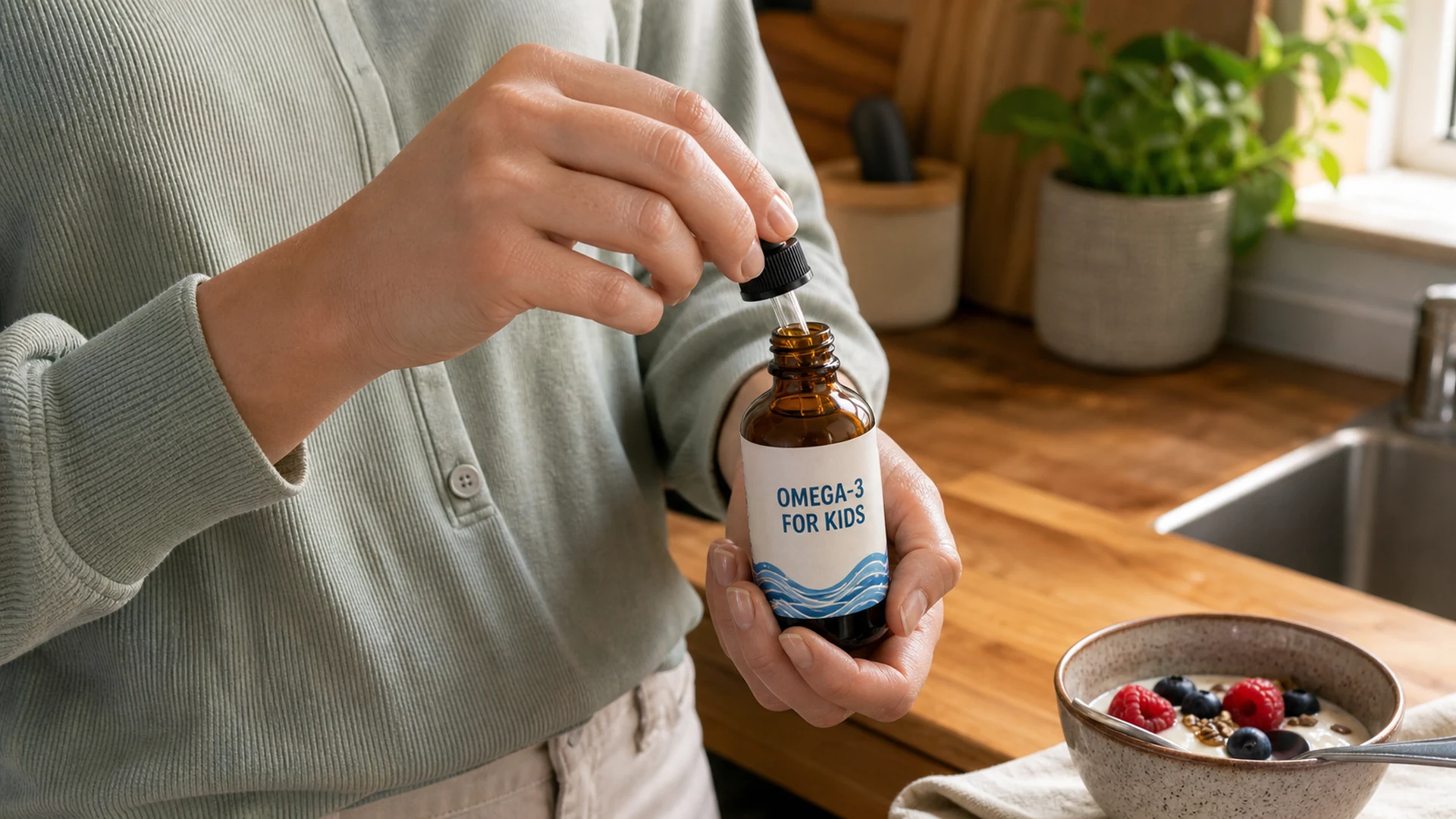
Before comparing products, I went through lab reports, retailer listings, and the actual studies — because too many omega-3 articles recycle the same benefits list or jump straight to product links before answering the real question: does a picky eater actually need an omega-3 supplement, or is this another wellness-industry upsell? Here’s what stood out, including which products I’d actually put in my own cart.
One thing this article doesn’t cover: specific dosage recommendations. That’s your pediatrician’s job, not mine. I’ll tell you what typical serving sizes look like on the labels I reviewed — but I won’t tell you what to give your specific child. Background on omega-3 intake research is at the NIH Office of Dietary Supplements.
For the broader picture, the family nutrition guide for kids is the parent hub for this series — it covers vitamins, brain foods, and which supplements are worth layering in, so you’re not building a stack based on marketing.
This page contains affiliate links and may include sponsored content. As an Amazon Associate, I earn from qualifying purchases at no extra cost to you. Amazon links are labeled #ad; other affiliate links may be marked as “affiliate link,” “Sponsored,” or “(paid link).” Affiliate Disclosure.
Table of Contents
- Do Kids Who Don’t Eat Fish Actually Need Omega-3 Supplements?
- What the Research Actually Says
- Fish Oil vs Algae Omega-3: The Honest Comparison
- Which Supplements Are Actually Worth Buying
- Picky Kid Omega-3 Matchmaker
- Two Liquid Picks: Fish Oil or Fish-Free?
- Gummies vs Liquid vs Chewable: What Works with Picky Kids
- Red Flags: What to Look for on Any Label
- Frequently Asked Questions
Do Kids Who Don’t Eat Fish Actually Need Omega-3 Supplements?
Let’s start with the question product roundups often skip. The short version: it depends on what your child actually eats. Food intake matters more than whether a bottle is marketed for “brain health.”
- Does your child eat fatty fish (salmon, mackerel, sardines) at least twice a week?
- Do they regularly eat walnuts, flaxseed, or chia seeds in meaningful amounts?
Regular fatty fish: that lowers the case for automatically adding a supplement.
Little or no fish: look at the rest of the diet and the reason you’re considering DHA before deciding whether a supplement adds value.
Here’s the part most articles skip: not every child needs a supplement. I would not use omega-6 intake or seed oils as a reason by themselves to add one. The more relevant question is whether the diet supplies preformed DHA/EPA from seafood or another source, and why a supplement is being considered. For children who do not eat fish and rely mainly on ALA from flax, chia, or walnuts, it is worth knowing that conversion to the longer-chain omega-3s is limited. An easy way to think about it: ALA is the raw material, and DHA is the finished product. The factory (your body) that converts one to the other is slow and only partially functional. NIH notes that conversion of ALA to EPA and then DHA is very limited (reported at under 15% overall), with direct EPA/DHA from food or supplements being the practical way to raise those long-chain omega-3s. I would not use a single 5–10% figure as if it were specifically the ALA-to-DHA rate for every child.
What the Research Actually Says
Here’s the nuance you won’t find in most articles, because it’s inconvenient for anyone selling supplements: the strongest evidence for omega-3 for kids supplementation is in children with actual deficiencies or ADHD. Recent meta-analyses on omega-3 supplementation in children find benefits for attention and cognitive performance, but they’re more modest for kids eating a generally balanced diet than for those with clear dietary gaps — the effect size is stronger when there’s an actual nutritional gap to fill. (I went back and read the source reviews rather than relying on secondary reporting; that nuance rarely survives intact.)
This doesn’t mean supplementing is pointless for average picky eaters — it means the brain isn’t going to fail without two months of gummies. The “brain window” isn’t closing because you haven’t started yet. DHA accumulation in the brain continues through adolescence. Starting a clean supplement now, for a picky eater who genuinely doesn’t get omega-3 from food, still matters. You haven’t missed anything permanent.
Routine omega-3 supplementation is not a universal pediatric recommendation. Intake guidance also differs across authorities, which is one reason I would not turn a blog comparison into a child-specific DHA dose. Use the label amounts to compare products, then match any supplement decision to the child’s age, diet, and reason for taking it.
Fish Oil vs Algae Omega-3: The Honest Comparison
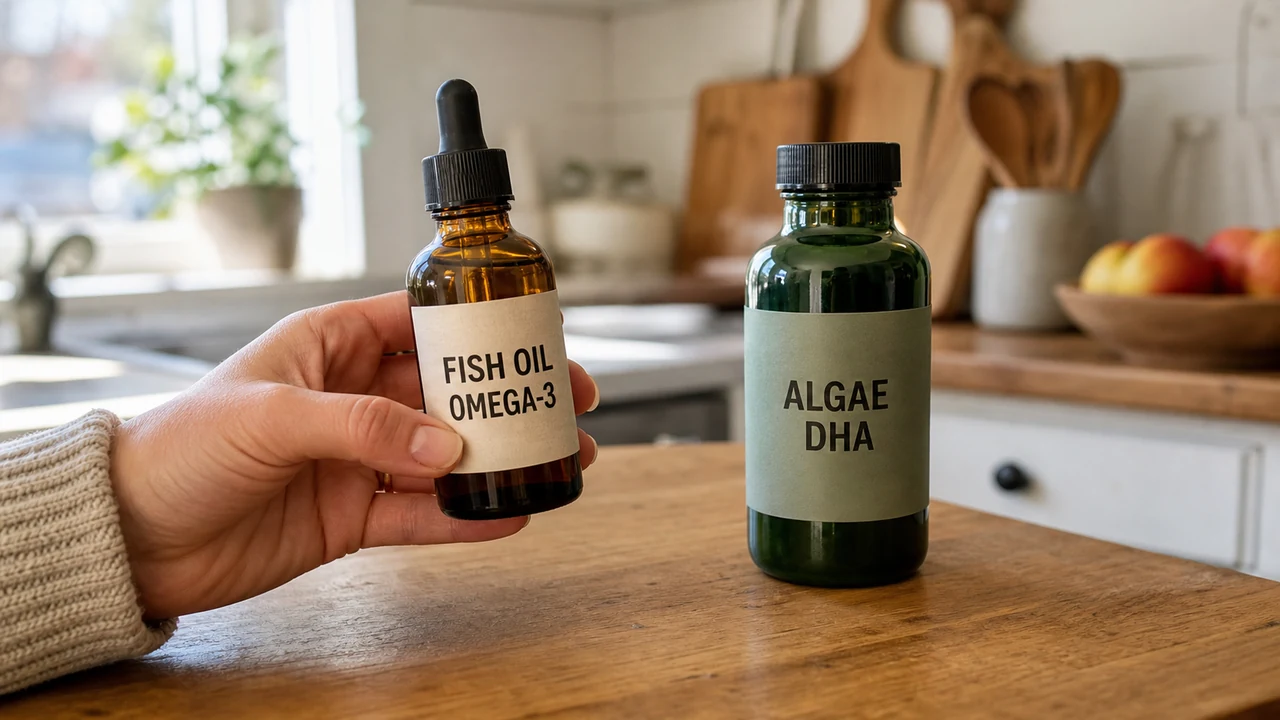
This is the question that gets a throwaway paragraph at the end of most articles. It deserves more than that — especially if fish isn’t an option in your house and algae omega-3 for kids is the realistic path instead. (If you’re also thinking about the broader picture of what nutrients support brain development, the foods that support kids’ brain development piece covers how DHA fits into the larger pattern.)
| Feature | Fish Oil | Algae Omega-3 |
|---|---|---|
| Source | Often anchovy, sardine, cod, or other fish sources; verify the exact source and purification/testing for the product | Farmed microalgae — where fish get their omega-3 in the first place |
| DHA content | Varies widely by product; compare the labeled DHA and EPA per serving | Varies widely by product; many algae oils are DHA-dominant |
| EPA content | Often provides both EPA and DHA; ratio varies by product | Often DHA-dominant, although EPA-containing algae products also exist |
| Bioavailability | Depends on the product and oil form; compare the current label and evidence rather than using source alone as a quality score | A direct DHA source; the practical comparison is the labeled amount, oil form, testing, and intended use |
| Taste / smell | May have a fishy odor or aftertaste; flavor and individual response vary | Avoids a fish source, but flavor and acceptance still vary by product and child |
| Fishy burps | Can occur; freshness, formulation, storage, and the individual all matter | Not a fish-oil issue, though any flavored oil or capsule can still have an aftertaste |
| Contaminant risk | Lower uncertainty when a current third-party purity/oxidation test or batch certificate is available; higher uncertainty when the product gives you nothing independent to verify | Controlled production avoids some ocean-source concerns, but product quality and independent testing still matter |
| Sustainability | Look for a current sustainability claim or certification and verify what it actually covers | No fishing is required; the broader environmental footprint still depends on production and product |
| Cost | Varies widely; compare current cost per labeled serving | Often higher; compare the current cost per labeled serving |
| Best for | Families comfortable with fish who find an age-appropriate, well-documented product | Families avoiding fish; check the full ingredient/allergen label for the specific product |
The honest verdict: algae is a legitimate direct source of DHA. EPA content varies widely by product, and there is not one universal DHA:EPA target for healthy children. If fish is off the table, algae omega-3 is a real non-fish option; compare the actual DHA/EPA amounts, current age label, and independent testing instead of treating one ratio as automatically better. If you are considering omega-3 for a specific clinical concern such as ADHD, use clinician guidance rather than choosing by ratio alone.
With the source decision settled, here are the products that survived the label, format, and verification check.
Which Supplements Are Actually Worth Buying
Finding the best omega-3 for kids means looking past the packaging. The evidence is most relevant when intake is genuinely low; ADHD trials have also been studied, but results are mixed and do not make omega-3 a stand-alone ADHD treatment. For the products below, I checked current manufacturer/retailer labels and named third-party certification information where it was publicly verifiable. I also compared format and common compliance barriers without pretending I personally tested each product. DHA and EPA figures can change with reformulation, so verify the live label before purchasing.
Products are listed in alphabetical order within each category. iHerb is the primary source where available.
| Product | Format & practical fit | Source | DHA / EPA per serving | Verification | ~Price/month |
|---|---|---|---|---|---|
| Nordic Naturals Children’s DHA Compare the liquid picks ↓ |
Strawberry liquid; current label ages 1–6. Chewable soft gels also exist—verify the exact format and age label. | Fish · anchovy/sardine · TG | 255 mg / 170 mg (530 mg total omega-3s) | Purity tested; current Nutrasource listing shows IGEN non-GMO certification | ~$22–$28 |
| California Gold Nutrition Kids Liquid Omega-3 | Lemon-flavored liquid. Useful when liquid is acceptable; flavor preference varies. Compare the current label and testing page before buying. | Fish · anchovy/sardine/mackerel · TG | 230 mg / 370 mg | iTested / retailer verification; check current lot testing | ~$12–$16 |
| Garden of Life Kids Plant Omega-3 Compare the liquid picks ↓ |
Fish-free liquid for families avoiding fish. Taste acceptance is individual. | Algae · vegan | Check current label — formula has changed | Non-GMO Project Verified; Certified Gluten Free and Certified Vegan on the current brand page | ~$28–$35 |
| Nordic Naturals Algae Omega | Fish-free soft gels. Consider only when the child can safely swallow them, and verify the current age label. | Algae · vegan | 195 mg / 135 mg | Non-GMO, 3rd-party tested | ~$30–$38 |
| Carlson Kid’s Chewable DHA Check Price on Amazon → |
Orange-flavored chewable soft gel labeled for ages 4+. Useful when liquid is refused, but lower in DHA than the liquid leaders. | Fish · TG | 100 mg DHA / 50 mg EPA | Current retailer label shows IFOS / IGEN claims; brand also reports independent purity testing | ~$29 (180ct) |
| SmartyPants Kids Formula (gummy) Check Price on Amazon → |
Familiar gummy format for some children, but the listed DHA/EPA amount is much lower than the liquid picks. | Fish | 46 mg / 27 mg | 3rd-party tested | ~$18–$22 |
Use the three-question matchmaker below to narrow the shortlist by age, fish-free needs, and the format your child will realistically take.
Picky Kid Omega-3 Matchmaker
Answer three questions — get a format-aware match without pretending every child needs the same product.
How old is your child?
If the matchmaker points you toward a liquid, or you simply want to compare the two liquid routes, this side-by-side makes the trade-offs clear. The main decision is fish oil versus fish-free, alongside the current age label and what your child will realistically take.
Two Liquid Picks: Fish Oil or Fish-Free?
Nordic Naturals vs Garden of Life
VSQuick pick: Choose Nordic Naturals when fish is acceptable and the current ages 1–6 liquid label fits. Choose Garden of Life when avoiding fish and its current age and formula label fits.
| Product | Nordic Naturals Children's DHA | Garden of Life Kids Plant Omega-3 |
|---|---|---|
| Source | Fish oil · TG form | Algae · fish-free |
| Why choose | Clearly listed DHA/EPA amounts and a current liquid label for ages 1–6. | A non-fish liquid when avoiding fish is the deciding requirement. |
| Consider | Strawberry flavor does not guarantee acceptance; skip it when fish is excluded or the age label does not fit. | The formula has changed; verify current DHA/EPA amounts, certification, and age label. |
| Shop |
If liquid is the barrier, the comparison table above includes Carlson's age-labeled chewable and the lower-DHA SmartyPants gummy. A familiar format can be easier for some children, but no flavor or format guarantees acceptance.
Gummies vs Liquid vs Chewable: What Works with Picky Kids
The form your kid will actually take is the right form — everything else is secondary. A supplement with perfect purity that gets fought over every morning is worthless.
| Form | DHA dose | Picky-kid acceptance | Practical reality | Best for |
|---|---|---|---|---|
| Gummies | Low (30–80 mg DHA) | Gummy format; individual acceptance varies | DHA dose is often inadequate as a sole source; can get sticky in heat; easy to accidentally double-dose | Starting the habit; bridge product while transitioning; ages 2+ |
| Flavored liquid | High (200–530+ mg DHA) | Liquid format; flavor and acceptance vary by product and child | Easily added to smoothies or juice; some kids take it off the spoon; needs refrigeration after opening; use within 3 months | Toddlers through age 8; picky eaters who won't swallow anything |
| Chewable soft gels | Medium-high (150–250 mg DHA) | Chewable format; suitability depends on age, chewing skills, and the product label | Often lemon or fruit-flavored; more portable than liquid; less sticky than gummies | Ages 4–10; kids who've graduated from gummies |
| Swallowable capsules | High (200–500+ mg DHA) | Lower for young kids; fine for 8+ | Best for older kids; highest DHA options are in this form | Ages 8+ |
For the 11+ crowd specifically, a teen-dosed option worth knowing about: Nordic Naturals Ultimate Omega 2X Teen soft gels (1,120 mg total omega-3) — a higher dose formulated for older kids/teens, not a generic adult product.
The practical format trade-off is straightforward: liquid omega-3 can be mixed into a smoothie or yogurt, while gummies and capsules are easier to dose visibly but may be less convenient for younger children. Fish-oil liquids can have more odor than algae-derived DHA, so flavoring and storage matter. Follow the product's storage directions rather than assuming every gummy or liquid needs refrigeration.
Red Flags: What to Look for on Any Label
Quick note: certification names are not interchangeable. IFOS is a fish-oil testing program, IGEN addresses GMO testing, and NSF/USP programs have their own scopes. A named, current program or accessible certificate is more useful than a vague “third-party tested” badge.
- No named testing program, current certificate, or accessible batch information — not an automatic failure, but it gives you less independent information to verify.
- DHA under 100 mg per serving in products marketed as a primary omega-3 source — many gummies fall here. If the label is positioning the product as a standalone daily DHA supplement for school-age kids, under 100 mg per serving is a gap worth knowing about.
- Ethyl ester (EE) form — check the label. Triglyceride (TG) form absorbs better. EE is cheaper to produce and common in lower-tier supplements.
- Rancid or very strong fishy smell on opening — fresh fish oil has some smell, but genuinely rancid oil smells stale or paint-like. Oxidized oil (high TOTOX value) is what you're avoiding — TOTOX measures total oxidation in the oil, and lower numbers mean fresher, more stable product. Persistent burp-back fish smell in kids is often a signal.
- No expiration date or lot number — makes it impossible to verify the certificate of analysis.
- Sugar as a top-3 ingredient — especially in gummies; common in kids' products that prioritize taste over dose.
- No sustainability mention for fish-based products — MSC certification or equivalent is a basic bar. Anchovy and sardine sources are generally lower-risk than salmon.
Certification status changes, and not every reputable product uses the same program. I would verify the exact current certification or batch-testing page for the specific SKU rather than assume an old IFOS badge still applies. If you're evaluating other kids' supplements alongside this, the best vitamins for kids guide uses the same named-verification approach across the broader supplement category.
Frequently Asked Questions
The Bottom Line
If a child regularly eats fatty fish, a supplement may add little; if fish is absent, algae-derived DHA or another omega-3 supplement can be a discussion point rather than an automatic requirement. The product still has to fit the child's age, diet, and reason for using it. (If breakfast is your other daily battle, 20 Healthy Breakfast Ideas for Kids has practical options organized by prep time and breakfast format.)
If liquid fish oil fits the child and current label, Nordic Naturals Children's DHA is the fish-oil benchmark in this comparison. If you're avoiding fish entirely, the Fish Oil vs Algae comparison above explains why algae-derived DHA is a direct non-fish source. Format matters, but I would not prescribe a gummy-to-higher-DHA progression or a timeline without a child-specific reason and dose plan.
Before buying anything, look for a named testing or certification program and verify what it actually covers. For Nordic Naturals Children's DHA, the current product page says purity tested and the current Nutrasource listing shows IGEN certification; an old IFOS report should not be presented as if it were the current certification.
Nothing here is medical advice. I research supplement evidence, labels, and certification carefully, but I'm not a healthcare professional. Individual children vary. Check with your child's pediatrician before starting a new omega-3 supplement, particularly for children under 2, those with known allergies, or kids taking medications that may interact with omega-3s.