
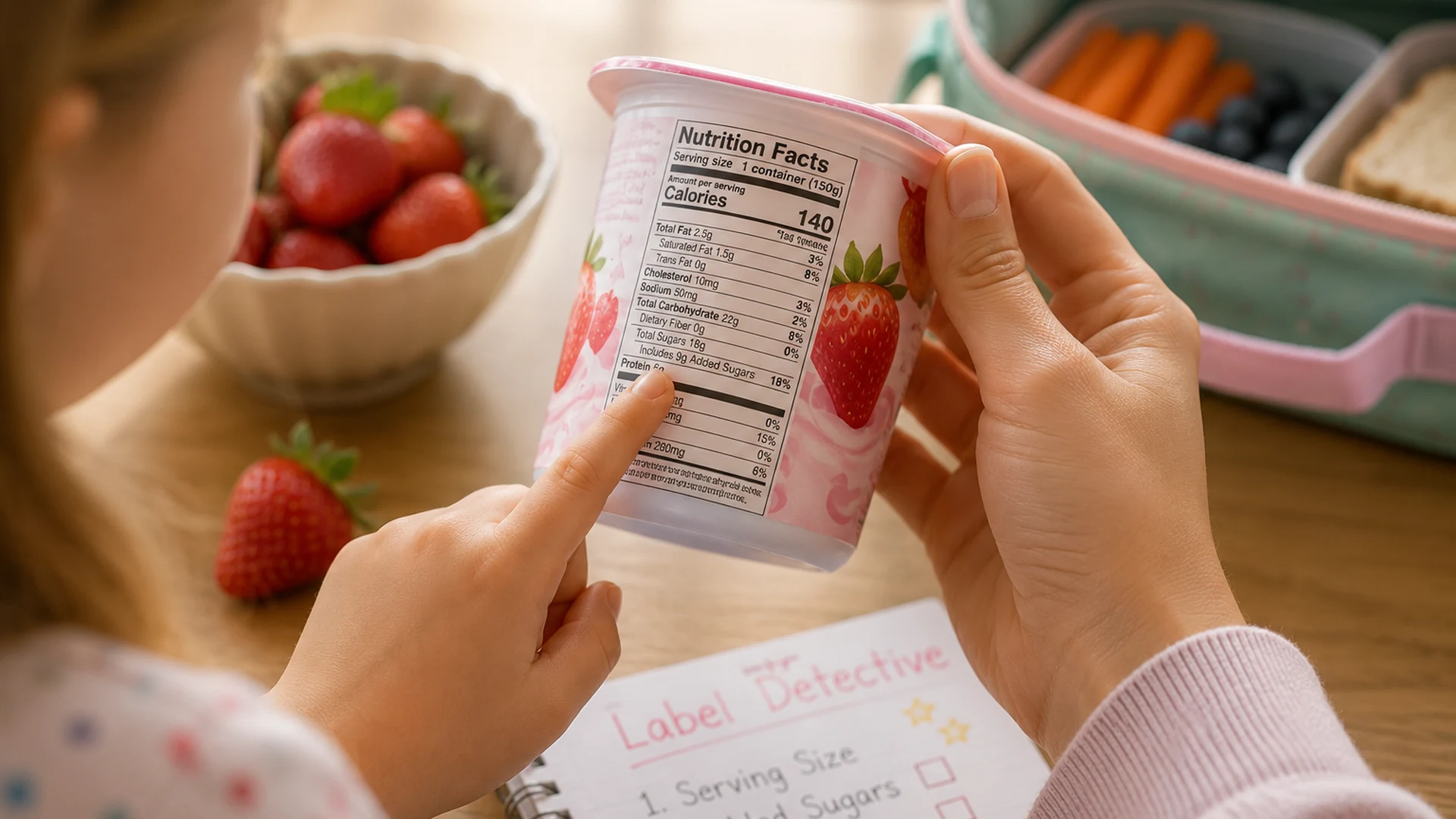
“Real strawberries” sounds useful until you try to explain what it actually tells you about the food. A strawberry yogurt can make that claim on the front and still leave you with the harder question: what does the Nutrition Facts panel actually mean?
I wanted a label-reading system simple enough to explain to a child: what matters first, what can wait, and how to turn the numbers into an actual grocery decision. This isn’t about reading the label faster — it’s about handing your kid the skill to do it themselves. Here’s the system I landed on and how to use it on a real grocery trip.
Table of Contents
- You Don’t Need to Read the Whole Label
- Step-by-Step: How to Read Nutrition Labels for Kids
- Total Sugar vs. Added Sugar: The Clarity Moment
- What the Numbers Mean for Your Child
- Added Sugar Budget Calculator
- Teaching Your Kids: Scripts That Actually Work
- Real Snacks: A Comparison Table
- Ingredients, Claims, and What’s Coming
- Frequently Asked Questions
This post is about the mechanics of reading the label itself — the numbers, not the bigger picture. If you want the full research on how much sugar kids should have day to day, my guide on how much sugar should kids have per day covers where it hides in foods marketed as healthy and what the daily limits actually mean.
You Don’t Need to Read the Whole Label
Most nutrition label articles cover everything: calories, total fat, saturated fat, trans fat, cholesterol, sodium, total carbs, dietary fiber, total sugars, added sugars, protein, and 8 different vitamins. That’s 15+ data points per product.
You don’t need any of that. Not for everyday grocery decisions with kids.
When I’m evaluating a kids’ snack, I check exactly three things (in this order) and everything else gets ignored until it becomes relevant.
- Serving size — how much counts as “one serving”?
- Added sugar grams — not total sugar; specifically the added line
- Ingredients list — what are the first three ingredients?
That’s the whole system. One honest caveat: a snack can score green on added sugar while still being nutritionally thin in other ways — low fiber, high sodium, nothing much of value. The three-thing triage is a fast filter for the most common trap (hidden added sugar), not a complete nutrition audit. Once you’re comfortable with it, the “Once You’re Comfortable” section below covers what to look at next.
Step-by-Step: How to Read Nutrition Labels for Kids
Here’s the exact order I go through it. Each step takes about five seconds once you know where to look.
Step 1: Find the serving size — and do the math
The serving size sits at the very top of the Nutrition Facts panel. Every other number on the panel is tied to it. A bag can look like a 90-calorie snack until you notice the serving is 14 crackers and the amount actually eaten is closer to half the bag.
Here’s the trap: a bag of chips might say “150 calories” — but the serving size is 11 chips. If your kid eats the whole bag (28 chips), you’re multiplying every number by roughly 2.5. A snack that looks moderate on paper becomes significant in practice. The question to ask before anything else: “How many servings are actually in this package, and how much will we realistically eat?”
Step 2: How to Find Added Sugar on the Label
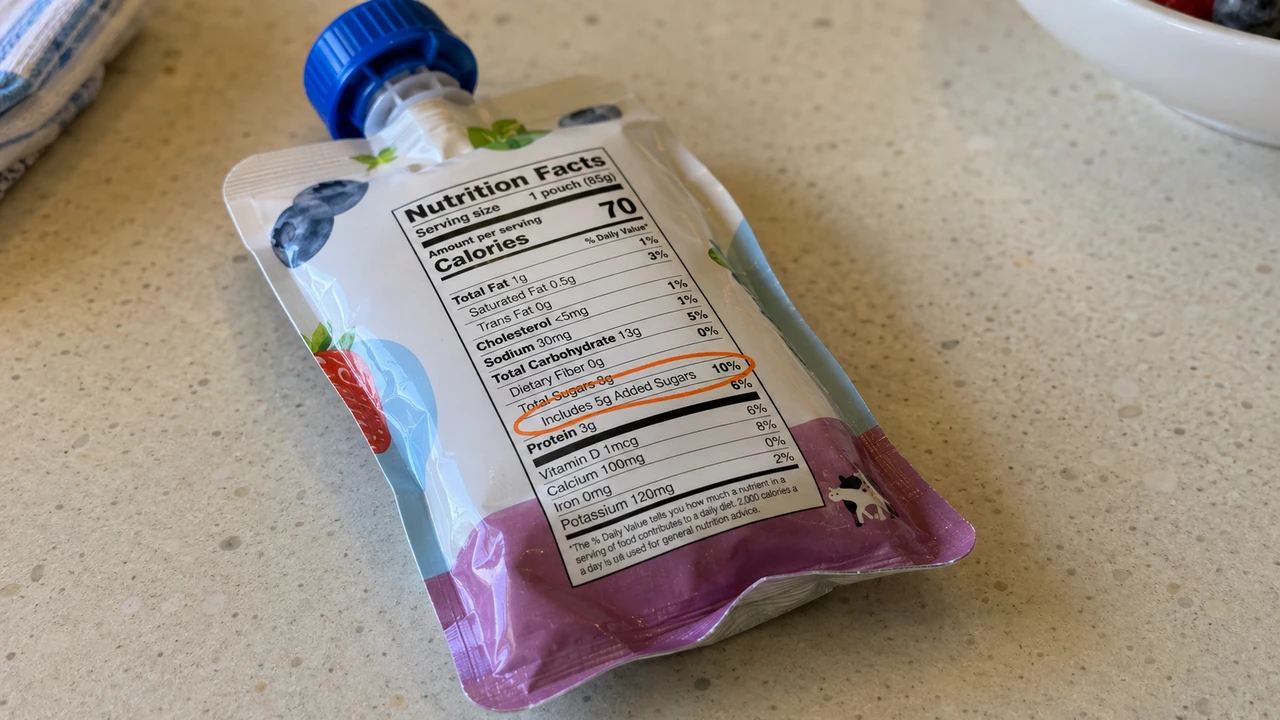
Scroll past calories, fat, sodium, and carbohydrates. You’ll see “Total Sugars” with a number. Underneath it, slightly indented, is the line you want: Includes Xg Added Sugars — [X]% Daily Value.
That indented added-sugar line has been required since 2020 — the FDA now mandates that food companies list added sugars separately. Before that update, you couldn’t tell the difference between natural and added sugar at a glance. Now it’s right there, mandatory, on every label.
Step 3: Check the % Daily Value — but adjust it for your child
The % Daily Value next to added sugars is based on an adult 50g Daily Value, so it is not a child-specific target. For a separate comparison, the American Heart Association uses a 25g/day added-sugar ceiling for ages 2–18. That means a label showing 10% DV (5g) is 20% of the AHA 25g benchmark. Current 2025–2030 federal guidance is stricter for children younger than 11, recommending no added sugar at all.
A quick FDA label rule of thumb is that 5% DV or less is generally low and 20% DV or more is generally high. For added sugar, doubling the label percentage gives you the share of the AHA 25g benchmark — not a universal child-specific daily limit. For children younger than 11, current federal guidance is stricter than that benchmark.
Step 4: Glance at the first three ingredients
Ingredients are listed by weight — largest first. If any form of added sugar appears in the first three ingredients, the product is built around sweetness — even if the front says “natural” or “made with real fruit.” The most common names: corn syrup, cane sugar, dextrose, maltose, honey, fruit concentrate, and anything ending in “-ose.” You don’t need to memorize them all. Just check: is something sweet-sounding one of the first three things? That answer tells you a lot.
Total Sugar vs. Added Sugar: The Clarity Moment
The total sugar vs added sugar label distinction is where most parents get stuck, and for good reason — the label shows two sugar numbers right next to each other and doesn’t explain the difference.
Total sugar includes everything: naturally occurring sugars from milk and fruit, plus any sugar added during production. Added sugar is only the sugar a manufacturer put in — it wasn’t naturally part of the food. Why does the distinction matter? Because fruit has sugar. Plain yogurt has sugar from milk. A flavored Greek yogurt with added sugar and a plain Greek yogurt with zero added sugar can have similar total sugar counts. The total sugar line makes them look equivalent. The added sugar line tells you they’re very different products.
Here is one label-reading example using a Chobani Kids strawberry pouch:
*%DV is based on the adult 50g Daily Value.
AHA comparison for ages 2–18 = 25g/day; current federal guidance recommends no added sugar for children younger than 11.
The label shows 8g total sugar — but 5g of that was added. The other 3g comes naturally from the milk. That 10% DV is based on the adult 50g Daily Value. Against the AHA 25g/day benchmark for ages 2–18, 5g is 20%. For a child younger than 11, the current federal guidance is stricter and recommends no added sugar.
This isn’t a reason to throw the pouch away. It’s a reason to know what you’re working with for the rest of the day. For a younger child, I would explain it simply: “See how total sugar is 8 grams but 5 of those are added? The label is showing us how much sweetness was added during processing.”
Once those two numbers make sense, the useful next step is repeating the check on a few real packages until it feels automatic. The checklist below gives you a simple structure for that practice.
Practice the Label Check With the Hidden Sugar Checklist
Inside: the 30-second label check, current label examples, common added-sugar names, practical swaps, and fridge-and-shop checklists.
Get the checklist and practical kids’ nutrition tips. Unsubscribe anytime.
Something went wrong. Please check your email address and try again.
What the Numbers Mean for Your Child
Here’s the Nutrition Facts for kids explained simply — no jargon, just the numbers that matter. The American Heart Association uses a 25g/day added-sugar ceiling for ages 2–18. The newer 2025–2030 federal guidance is stricter: no added sugar for children younger than 11; for adolescents and adults, no amount is considered part of a healthy diet and a meal should contain no more than 10g. The table below uses the AHA number as a comparison benchmark, not as permission to aim for 25g.
| Added Sugar per Serving | % of Child’s Daily Budget (25g) | Verdict |
|---|---|---|
| 0–3g | 0–12% | ✓ Good to go as a daily snack |
| 4–8g | 16–32% | Fine — watch the rest of the day |
| 9–15g | 36–60% | Occasional treat, not an everyday snack |
| 16g+ | 64%+ | More than half the day in one snack |
These aren’t hard rules. They’re reference points. A kid who eats mostly whole foods and has one 12g added-sugar snack is fine. A kid who hits 8g at breakfast, 8g at snack time, 8g after school, and 8g after dinner has gone well past the daily guideline before dinner even starts. The goal isn’t obsessive gram-counting. It’s knowing what range you’re in.
Use the calculator below to see exactly where a specific snack lands for your child.
Added Sugar Budget Calculator
See how this snack fits the day
Use the numbers from the package and the amount your child actually eats.
Find “Includes Added Sugars” on the label.
Half a serving is 0.5; two servings is 2.
Complete the three quick steps to see the added sugar total in context.
Teaching Your Kids: Scripts That Actually Work
The goal here isn't for you to read labels faster. It's to teach your kids to read them — so the decision comes from them, not from you saying no at the checkout line. Every other article on this topic teaches the parent. This section is about making yourself unnecessary.
The scripts below are split by age. The calculator above now separates children younger than 11 from ages 11–18 so the current federal guidance does not get blurred into the older AHA benchmark. The scripts are about teaching the label skill, not asking a child to police a medical "sugar budget."
Before the scripts, here's the single sentence I use to explain it to any age: "Natural sugar comes with the food. Added sugar is sugar someone put in." For younger kids I'll add the example: "An apple has natural sugar. Apple candy has added sugar — that's the kind we watch." It's simple enough that they'll remember it in the store without you there.
Here is wording I would use by age:
For ages 5–8: Start with the concept, not the numbers. Kids this age can understand that some sweetness is natural and some is added by a factory.
"See this yogurt? It says strawberry on the front. Strawberries have their own natural sugar — that's fine. But see this line here? [point to Added Sugars] This tells us how much extra sugar the factory added after the strawberries were already in. This one has 5 extra grams — that's like sneaking in a teaspoon of sugar that didn't need to be there."
Then make it a comparison game: "Can you find one with less than 5 on this line?" Let them hunt. They will.
For ages 9–12: They can handle the math and the budget concept.
"This snack has 10 grams of added sugar. That is a lot for one item, so let's compare it with another option and see what changes. The label helps us compare — it is not a score for whether a food is good or bad."
Give them the decision. They take it more seriously when it's theirs to make.
Once they can spot it on their own, the next step is putting it to work — here's how it plays out with snacks you've probably already got in the pantry.
Real Snacks: A Comparison Table
Here's how this plays out with products you've likely bought or considered. The numbers below are based on labels reviewed during research for this article, not estimates. The verdicts are context-dependent: a kid eating mostly whole foods can absolutely have a "sometimes" snack daily. These are reference points, not sentences. All servings are based on the manufacturer's listed serving size.
| Product | Serving Size | Added Sugar | % of Kids' 25g Budget | Verdict |
|---|---|---|---|---|
| Plain Greek yogurt (e.g. Fage 2%) | ¾ cup | 0g | 0% | ✓ Excellent daily choice |
| Chobani Kids strawberry pouch | 1 pouch (85g) | 5g | 20% | ✓ Fine daily |
| Danimals strawberry smoothie | 1 bottle (93ml) | 9g | 36% | Occasional — not every day |
| Quaker Chewy Granola Bar (choc chip) | 1 bar (28g) | 7g | 28% | Fine — watch the rest of the day |
| Nature Valley Oats & Honey bar | 1 bar (21g) | 5g | 20% | ✓ Fine daily |
| Fruit Roll-Up (1 roll) | 1 roll (14g) | 7g | 28% | Small but dense — occasional |
| Capri Sun Fruit Punch (1 pouch) | 1 pouch (177ml) | 16g | 64% | Over half the daily budget |
Numbers based on labels reviewed during research for this article — always check your own package, since formulations can change.
The Capri Sun example is the one that stands out in this comparison because the pouch looks small. Using the AHA 25g/day benchmark, the listed amount is 64% of that number; the Nature Valley bar example is 20%. For children younger than 11, current federal guidance is stricter than either percentage. Front-of-package marketing is almost useless for making this comparison. The label gives you the actual added-sugar number.
Once You're Comfortable: Ingredients, Claims, and What's Coming
Once the three-thing triage feels automatic, here's a quick orientation to the parts I check occasionally. I want to be upfront: I'm not a nutritionist, and some of this gets complicated fast. What follows is what I've found useful — but for anything clinical or health-specific, your pediatrician knows your kid's situation better than any label guide.
Hidden sugar names in the ingredients list. Added sugar appears under more than 60 names. The most common ones to watch: corn syrup, high-fructose corn syrup, cane sugar, brown rice syrup, dextrose, maltose, evaporated cane juice, and anything ending in "-ose." One thing worth knowing: manufacturers sometimes split sugar into multiple forms across the ingredients list. This pushes each individual form lower on the list while the total added sugar remains the same. The Added Sugars line on the Nutrition Facts panel catches this automatically — the ingredients hunt is just a useful backup. According to the FDA's Nutrition Facts label guidance, the current format was specifically designed to make added sugars more visible to consumers.
Front-of-package marketing claims. "No artificial colors." "Made with whole grains." "Good source of vitamin C." None of these tell you anything about added sugar. They're regulated marketing statements, not nutritional quality markers. A product can be "made with real fruit" and still have 14g of added sugar per serving — the front of the package will not tell you this.
"Organic" and "natural" don't mean low-sugar. Organic cane sugar is still added sugar — it just comes from a certified-organic source. A USDA Organic seal tells you about farming practices, not about how much sugar a manufacturer put in. I've found organic toddler snacks with more added sugar per serving than their conventional shelf-mates. The Added Sugars line is still the number that matters, organic label or not.
The proposed FDA Front-of-Package label. As of publication, the FDA has proposed a new front-of-package label that would display Low/Medium/High ratings for saturated fat, sodium, and added sugar. It's still being finalized — even once a rule is issued, food companies would likely have several years to comply. For now, the Nutrition Facts panel on the back is still where the real information lives.
If you're building on this and want the bigger nutrition picture — how all the label numbers connect to what growing kids actually need each day for vitamins, omega-3s, and brain development — I cover that in my full guide to feeding kids for everyday health.
Frequently Asked Questions
Conclusion
Knowing how to read nutrition labels for kids is one of those skills that takes about one grocery trip to learn and lasts for years. Start with the three-thing triage, focus on the added sugar line, and hand the label to your kid once you've shown them what to look for. That's the whole goal — not a parent who reads labels faster, but a kid who reads them at all. Try it on one snack this weekend and see what your kid notices.
Nothing on this site is medical or nutrition advice. I research labels and nutrition guidance carefully, but I'm not a healthcare professional. Sugar needs vary by age and individual health context — check with your child's pediatrician before making significant changes to their diet.