
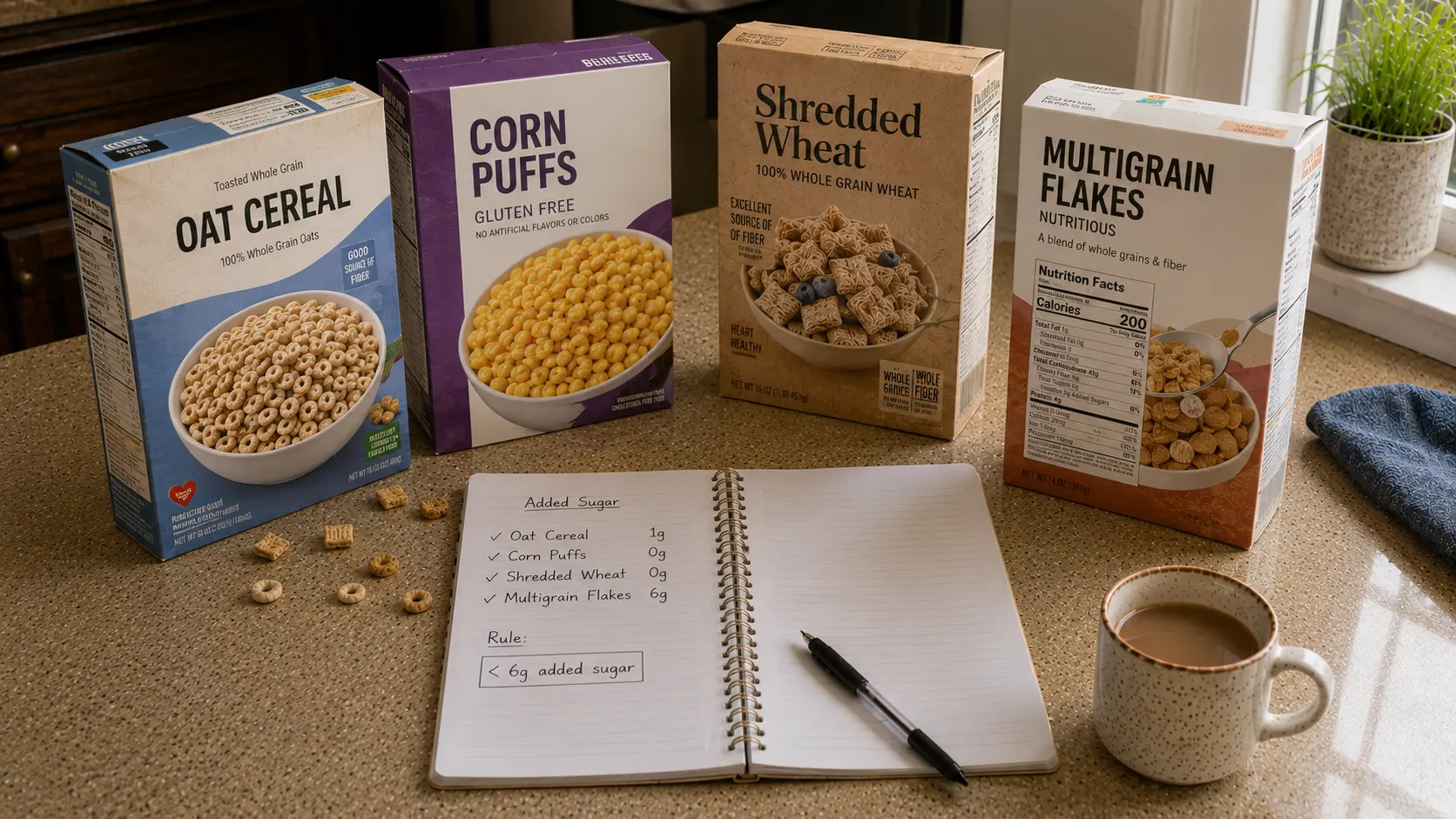
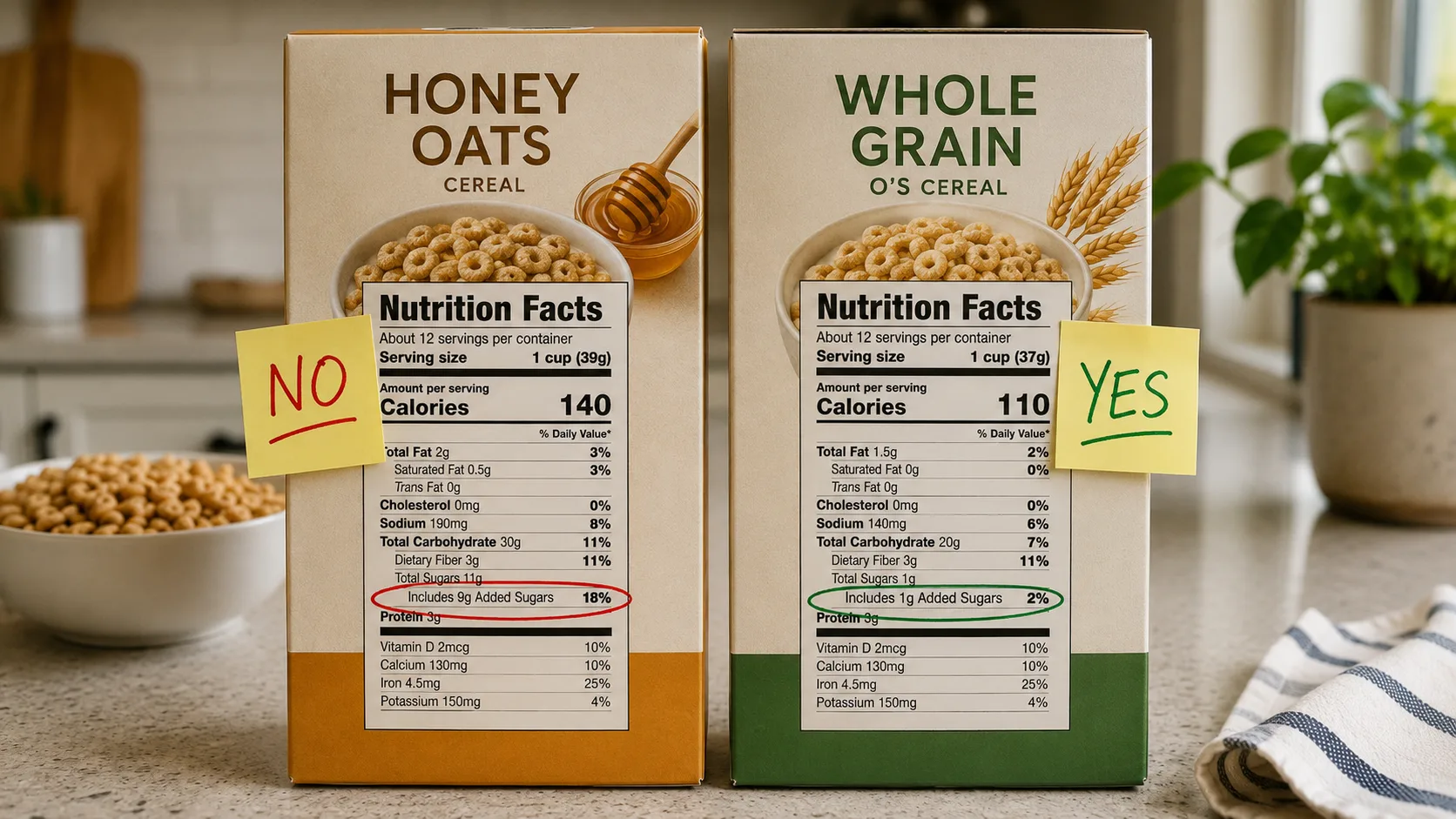
Honey Nut Cheerios looked like an obvious baseline. Then I checked the current label: 12 grams of added sugar. That was the number that made me stop judging cereal by the front of the box and start comparing the labels side by side.
I went through 30+ boxes — specifically hunting for the best low sugar breakfast cereal for kids — comparing added sugar, fiber, protein, serving size, ingredients, price, and availability. The point wasn’t to find the lowest number at any cost. A useful cereal also has to make sense for an ordinary school morning, so practicality wasn’t optional.
Here’s what I found — the cereals that made the cut, including a few brands I fully expected to pass that didn’t. Every pick below cleared the same screen: under 6g added sugar, a defensible ingredient profile, practical price/availability, and a format that makes sense for a regular breakfast.
If you want the bigger picture — how much added sugar kids should actually have in a day, and where it hides beyond the cereal aisle — that’s covered in detail in my how much sugar should kids have per day. But if you’re here for the cereal list, let’s get to it.
This page contains affiliate links and may include sponsored content. As an Amazon Associate, I earn from qualifying purchases at no extra cost to you. Amazon links are labeled #ad; other affiliate links may be marked as “affiliate link,” “Sponsored,” or “(paid link).” Affiliate Disclosure.
Table of Contents
- The Rule I Use (and Where It Comes From)
- Find Your Best-Fit Cereal (Interactive Tool)
- The Comparison: 11 Cereals From My 30+ Label Review
- Why Most Parents Read the Wrong Sugar Number
- My Low-Sugar Breakfast Cereal Picks (And the Ones That Failed)
- The Ones That Didn’t Make It
- If Your Kid Won’t Eat It: A Realistic Transition Plan
- Frequently Asked Questions
- Conclusion
The Rule I Use (and Where It Comes From)
The quick screen: Under 6g of added sugar per labeled serving, with at least 2g of fiber. That keeps one bowl to roughly a quarter of the American Heart Association’s 25g daily added-sugar ceiling for ages 2–18.
Fortification can be useful, but it is a bonus—not a pass. I still compare the label, fiber, ingredients, price, and whether a child will realistically eat it.
Notice that threshold is for added sugar, not total sugar. That distinction matters, and I explain why it changes what you’re looking for on the label in the insight section below.
Find Your Best-Fit Cereal
Answer two quick questions and get one practical place to start.
How strict do you want to be on sugar?
Start with your sugar target. Your second choice will narrow it to one realistic cereal to try.
The Comparison: 11 Cereals From My 30+ Label Review
I compared nutrition labels across more than 30 cereal options, recording added sugar, fiber, protein, and serving size. I expected the obvious “kids” cereals to be high in sugar; the more useful surprise was how many “healthy”-sounding boxes failed the same 6g screen. Below is the side-by-side for the cereals that made it furthest in that comparison. All numbers are per labeled serving, based on labels checked in early 2026. Sugar amounts shift when brands reformulate, so double-check the current box. Rows in red are products that failed the screen.
| Cereal | Added Sugar (g) | Total Sugar (g) | Fiber (g) | Protein (g) | Practical Fit | Notes |
|---|---|---|---|---|---|---|
| Plain Cheerios | 1 | 2 | 4 | 5 | Familiar, neutral | The baseline. Whole grain oats, genuinely low added sugar, and easy to pair with milk, fruit, or yogurt. |
| Cascadian Farm Purely O’s | <1 | 1 | 4 | 4 | Familiar, neutral | USDA Organic and very low in added sugar. It is not nutritionally identical to Cheerios, so compare the current label rather than treating the two as interchangeable. |
| Post Shredded Wheat (plain) | 0 | 0 | 8 | 7 | Very plain | Nutritionally the standout. Banana or berries can soften the jump from a sweeter cereal. |
| Rice Chex | 3 | 3 | 2 | 3 | Light texture | Low sugar and gluten-free. Fiber is low, so pair with a more substantial protein or fiber source. |
| Kix | 4 | 4 | 3 | 3 | Mild flavor | Under the sugar threshold with a familiar puffed-cereal format. Lower fiber, so pair it with something more substantial. |
| Barbara’s Puffins (Original) | 5 | 5 | 5 | 3 | Sweeter bridge | Right at the edge of my threshold, but the fiber is excellent and the slightly sweeter format can bridge from higher-sugar cereal. |
| Nature’s Path Flax Plus Multibran | 5 | 5 | 7 | 5 | Dense / whole-grain | High fiber, good protein, flaxseed for omega-3s. A half-and-half blend can make the texture shift less abrupt. |
| ✗ Honey Nut Cheerios | 12 | 12 | 3 | 3 | — | The one that looks deceptively close to plain Cheerios. It is not: the current label lists 12g added sugar per serving. |
| ✗ Kashi Go Lean Crunch | 11 | 13 | 9 | 9 | — | Impressive fiber/protein, but the current label still lands well above my under-6g added-sugar screen. |
| Nature’s Path Love Crunch (Dark Chocolate) | 6 | 6 | 2 | 2 | Small serving / granola | The current 1/4-cup label sits at the edge of this screen rather than clearly failing it. The catch is serving size: a cereal-size bowl can multiply those numbers quickly. |
| ✗ Raisin Bran (Kellogg’s) | 9 | 18 | 7 | 5 | — | Total sugar looks alarming partly because of the raisins (natural). Still, 9g added sugar is too high for daily use. |
Why Most Parents Read the Wrong Sugar Number
When I first started reading cereal labels, I was looking at the wrong number.
The “Sugars” line on a nutrition facts panel shows total sugars — which includes both naturally occurring sugar from ingredients (like raisins or oats) and sugar the manufacturer actually added. For a cereal made with dried fruit, the total number can look alarming even when the added sugar is modest.
The number you want is the Added Sugars line. It appears directly below the total sugars line on any label updated after 2020. That’s the sugar put in during manufacturing, and it’s the one you’re trying to minimize.
There’s also a labeling distinction worth knowing: “No sugar added” means no sugar was added during processing — but the food can still contain natural sugars. I’ll admit this one tripped me up early on. “Unsweetened” means roughly the same thing. Neither guarantees zero grams of sugar on the label. For most cereals in my table, both terms apply and the numbers are genuinely low.
One more: sugar hides on ingredient lists under names that don’t say “sugar.” Dextrose, maltose, cane juice, evaporated cane syrup, brown rice syrup, corn sweetener — these all count as added sugar on the nutrition panel, but they can look like legitimate ingredients if you’re only skimming. The “Added Sugars” line catches all of them regardless of what they’re called in the ingredients.
I covered the full range of hidden sugar names in kids’ foods in my hidden sugars article — worth reading if you want to apply the same label skills beyond cereal.
My Low-Sugar Breakfast Cereal Picks (And the Ones That Failed)
These are the best low sugar cereal for kids that passed my 6g threshold and still made sense after I compared fiber, ingredients, price, and everyday practicality.
My default pick: Plain Cheerios — 1g added sugar, whole grain oats, familiar format, easy to find.
Plain Cheerios — 1g Added Sugar
Whole grain oats, 1g added sugar, 3g fiber, 3g protein. They’re not exciting, which is part of the appeal: the flavor is neutral, the ingredient profile is straightforward, and they’re easy to serve with milk, fruit, or yogurt. This is the cereal I recommend first when someone wants the simplest low-sugar default.
Cascadian Farm Purely O’s — <1g Added Sugar
The organic equivalent of plain Cheerios. Similar nutrition profile, certified organic, and typically a dollar or two more. This is the option I’d choose when the organic label matters without sacrificing the numbers.
Barbara’s Puffins Original — 5g Added Sugar
This one sits right at the top of my range at 5g added sugar, but it earns its spot because the fiber is genuinely good at 5g per serving. The slightly sweet corn-puff format also makes it a useful bridge between sweeter cereals and the very plain options above. Pair it with plain Greek yogurt or another protein source if you want the breakfast to have more staying power.
Post Shredded Wheat (Unfrosted) — 0g Added Sugar
Zero grams of added sugar and 6g of fiber per serving make this the nutritional standout on my list. The catch is flavor: unfrosted shredded wheat is much plainer than the cereals most children are used to. Milk and sliced banana add sweetness without changing the added-sugar number much. If you’re moving from a sweeter cereal, use the gradual transition approach below rather than expecting this to feel equivalent on day one.
Nature’s Path Flax Plus Multibran — 5g Added Sugar
My pick when nutritional density matters most — 7g fiber, 5g protein, flaxseed, and 5g added sugar per serving. It is a denser, more whole-grain-forward cereal than the O-shaped options, so a half-and-half blend with a familiar cereal can make the transition less abrupt.
The Ones That Didn’t Make It
The failures are more useful than the wins. These are cereals I expected to pass because the packaging or nutrition reputation made them look like obvious healthy choices.
Honey Nut Cheerios: 12g added sugar on the current label. The useful lesson is how different it is from plain Cheerios despite the shared branding. If mild sweetness is the goal, plain Cheerios, Purely O’s, or a gradual blend give you more control over the added sugar.
Kashi Go Lean Crunch: The fiber and protein numbers here are genuinely impressive — 8g fiber, 9g protein. But 13g of added sugar makes it a no for daily breakfast. The label looks like health food because it’s dense with nutrients. The sugar is still there.
Special K (flavored varieties): Special K has a decades-old health reputation, and the original version has a reasonable 4g added sugar. But the flavored lines — Red Berries, Honey Almond, Nourish — typically run higher in added sugar, often 8–11g, though exact numbers vary by product and region and shift when Kellogg’s reformulates. Many parents buy these as the “grown-up healthy” option without realizing the flavored versions can land in the same sugar range as Honey Nut Cheerios.
Many granolas: Several granola cereals in the comparison landed around 10–14g of added sugar per serving, often with smaller serving sizes than a typical cereal bowl. That isn’t true of every granola, so check the specific label. One practical way to keep the sugar contribution smaller is to use a tablespoon or two as a topping rather than making granola the whole bowl.
The cereals that failed the screen make the broader lesson clear: the front of the box is not the shortcut. If you want to use the same comparison on other packaged foods, the checklist below gives you the repeatable label routine.
Compare Cereal Labels With the Hidden Sugar Checklist
Inside: the 30-second label check, current label examples, common added-sugar names, practical swaps, and fridge-and-shop checklists.
Get the checklist and practical kids’ nutrition tips. Unsubscribe anytime.
Something went wrong. Please check your email address and try again.
If Your Kid Won’t Eat It: A Realistic Transition Plan
A sudden switch from a sweet cereal to a very plain one can feel like a completely different breakfast. A gradual blend makes the flavor shift less abrupt:
- Start with a blend. If the child is comfortable with mixed cereals, try a mostly-familiar bowl with a smaller amount of the new cereal. Keep it ordinary rather than turning the swap into a test or a trick.
- Shift the ratio only if it is going well. Move toward more of the lower-sugar cereal over several breakfasts. There is no required 5–7 day schedule; the point is to make the flavor change smaller, not to force a deadline.
- Add flavor without adding sugar. Sliced banana, fresh or frozen berries, a small drizzle of honey, or a sprinkle of cinnamon. These do real work on palatability without pushing you back into sugar territory.
- Pair with something more substantial. A side of egg, Greek yogurt, milk, or nut/seed butter can add protein and make cereal less of a stand-alone carbohydrate meal.
- Offer a short list. Two or three workable options can give the child a real choice without turning breakfast into an unlimited menu: “Cheerios or Puffins?” is clearer than an open-ended negotiation.
There is no universal two-week timeline here. The point of the blend is simply to make the sweetness change smaller from one breakfast to the next. If Honey Nut Cheerios is the starting point, Puffins can work as a sweeter bridge before moving toward plain Cheerios or Purely O’s.
Frequently Asked Questions
Conclusion
Finding a good low-sugar breakfast cereal for kids doesn’t require reading 30 labels — it just requires knowing the right number to look for (added sugar, not total sugar). If you want the simplest low-added-sugar default, start with Plain Cheerios. If your kid is picky, Puffins works as the treat-like bridge. If you want the strongest nutrition numbers and have an adaptable eater, go with Shredded Wheat or Flax Plus. And if yours won’t touch any of them yet, the blend approach gets you there. The same added-sugar-not-total-sugar rule applies well beyond the cereal aisle — my breakdown of hidden sugars in “healthy” kids foods covers the other labels that catch parents off guard.
Buying just one? Plain Cheerios is the low-sugar default I’d hand most families — 1g added sugar, whole-grain oats, easy availability.
Everything here is based on label comparison, ingredient review, price/availability, and practical use-case tradeoffs — not a claim of household product testing. I’m not a dietitian or healthcare professional. If you have specific concerns about your child’s sugar intake, diet, or nutrition, please talk to your pediatrician. Nutrition label numbers can change when brands reformulate, so it’s always worth a quick check on the box before you buy.