
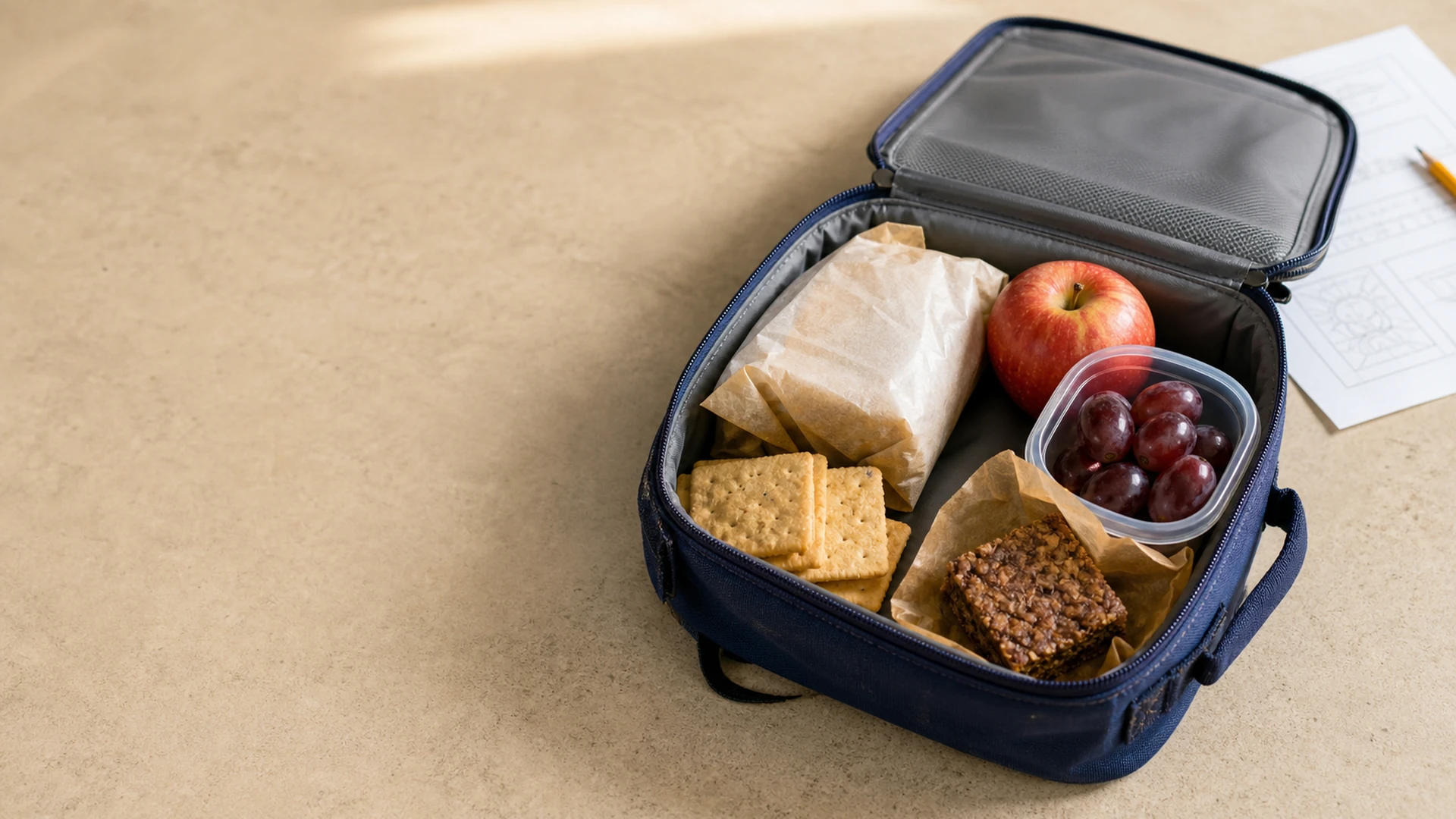
A rough afternoon after a sweet snack is easy to label a “sugar crash.” Before calling it one, it helps to separate what sugar can explain physiologically from the behavior myths it cannot.
A granola bar with 12 grams of added sugar can use almost half of the AHA’s daily ceiling for children. I wanted to know which parts of the familiar “spike and crash” story actually hold up, so I went source by source — current guidance plus research on glucose regulation, appetite, dental health, and the gut. This article is the biology behind what happens when kids eat too much sugar, in plain language, without pretending every rough afternoon has one cause.
Table of Contents
- How Much Added Sugar Is Actually Too Much?
- What a High-Sugar Snack Does — and What It Doesn’t Prove
- Daily Sugar Budget Calculator
- What Sugar Does to Your Child’s Gut
- Signs Your Child May Be Over the Limit
- The Hyperactivity Myth — Settled
- Long-Term Effects — Honest, Not Fearmongering
- What to Do Now — Without Drama
- Frequently Asked Questions
- Conclusion
This post focuses on the biology — what’s actually happening inside your child’s body. For the full picture on how much added sugar kids should have by age and where it hides day to day, my guide on how much sugar kids should have per day covers it in more depth.
How Much Added Sugar Is Actually Too Much?
The 25g AHA benchmark is still useful, but the 2025–2030 federal guidance is stricter: children younger than 11 should have no added sugar, and for adolescents and adults no amount is considered part of a healthy diet, with no more than 10g in a meal.
The 2025–2030 Dietary Guidelines for Americans recommend no added sugar for children younger than 11. For adolescents and adults, they say added sugar is not recommended as part of a healthy diet and advise keeping any one meal to no more than 10g. Separately, the American Heart Association uses a 25g/day ceiling (about 6 teaspoons) for ages 2–18. I would treat those as complementary guardrails rather than pretend they are one age-tiered rule.
These limits apply to added sugars only — not the natural sugar in whole fruit, milk, or plain dairy. That distinction matters a lot, and I’ll come back to it.
| Age | Daily Added Sugar Limit | What That Looks Like |
|---|---|---|
| Under 2 | 0g — none | Avoid added sugar under 2; current DGA says added sugar is not recommended as part of a healthy diet |
| Under 11 years | 0g recommended (2025–2030 DGAs) | Current federal guidance recommends no added sugar for children younger than 11 |
| 11–18 years | ≤25g / day (AHA) | AHA ceiling; current federal guidance also says no amount is considered part of a healthy diet and caps a meal at 10g |
| How fast it can stack | Varies by the foods and drinks chosen | One yogurt pouch (13g) + granola bar (12g) = 25g before lunch |
That last row is the useful reality check: a yogurt pouch plus a granola bar can reach the 25g AHA benchmark before lunch, even though neither product looks like candy.
What a High-Sugar Snack Does — and What It Doesn’t Prove: What Happens When Kids Eat Too Much Sugar
This is where the usual “sugar crash” story needs some restraint. A carbohydrate-heavy snack can raise blood glucose and trigger an insulin response, but healthy children do not all follow one predictable 120-minute behavioral script. Timing, portion size, the rest of the meal, activity, sleep, and individual metabolism all matter.
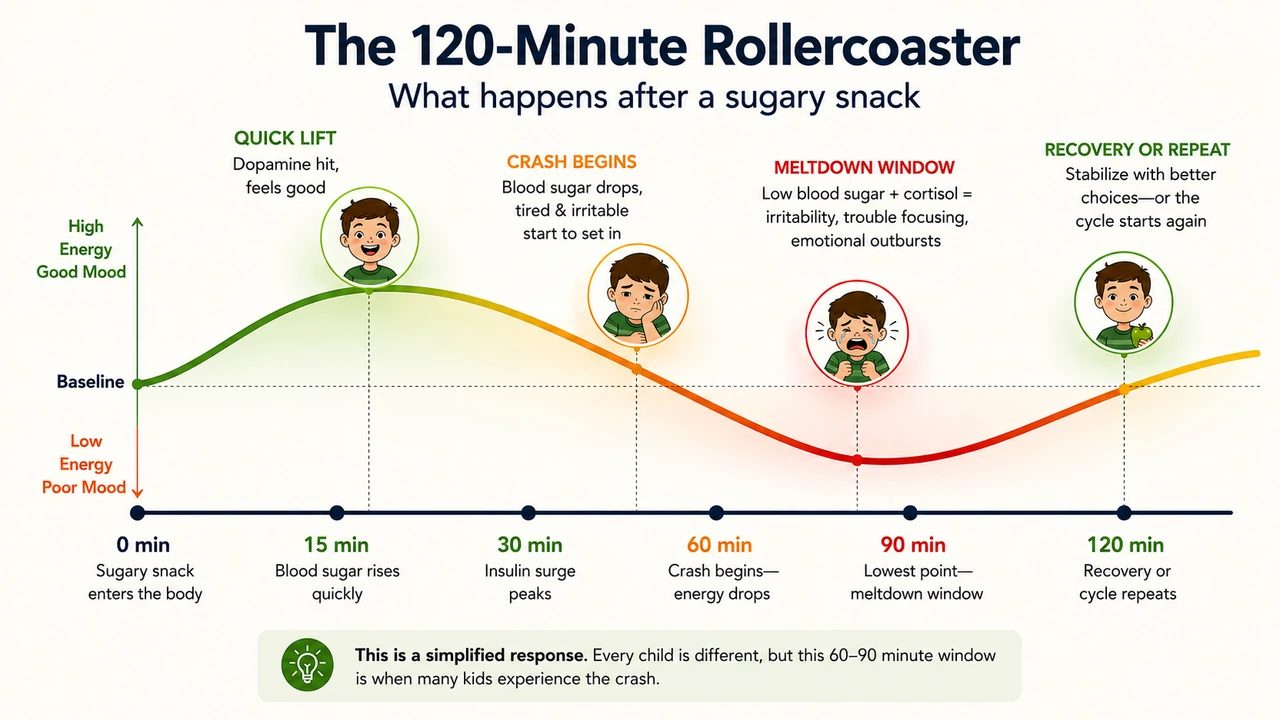
First 30 minutes: Sugars and refined carbohydrates are digested and absorbed, blood glucose can rise, and the pancreas releases insulin to help move glucose into cells.
Over the next couple of hours: Glucose generally moves back toward baseline. The size and speed of that change vary widely. A large drop below normal is not something you can diagnose from mood, tiredness, or a tantrum.
Hunger can return sooner after a less filling snack. A snack built mostly around rapidly digested carbohydrate may simply provide less protein, fat, or fiber than a more balanced option. That can matter for fullness without requiring a dramatic “insulin overshoot” explanation.
Behavior is not a glucose meter. Controlled studies do not support the classic idea that sugar directly makes children hyperactive. If a difficult afternoon reliably follows snack time, look at the whole pattern — hunger, sleep, timing, hydration, stimulation, and what the snack replaced — rather than assuming blood sugar caused the behavior.
The useful takeaway is less dramatic than a universal crash timeline: high added-sugar foods can take up a large share of the day’s sugar allowance while contributing relatively little fiber or protein. A 2019 review in Nutrients discusses links between glycemic variability and cognition, but it does not establish one universal 60–90 minute behavioral crash in healthy children. That is enough reason to compare the snack without turning every mood change into a metabolic diagnosis.
Most parents hit the daily limit before lunch — check yours:
Daily Sugar Budget Calculator
Select your child’s age and check what they ate today to see how it stacks up. The calculator uses the AHA 25g/day ceiling for ages 2–18 as its numeric benchmark; current federal guidance is stricter for children younger than 11.
Check what your child had today:
Your result
What Sugar Does to Your Child's Gut
The longer-term sugar and gut health in kids story is real enough to discuss, but it is easy to oversimplify. The gut microbiome responds to the whole dietary pattern — fiber, food variety, ultra-processed foods, medications, illness, and many other factors — not to one sweet snack in isolation.
Your child's gut contains trillions of microbes that interact with digestion, metabolism, and immune function. Diet can influence which microbes thrive, and research is actively studying how higher-sugar, lower-fiber dietary patterns relate to microbiome composition. What I would not do is turn that into the slogan that sugar simply “feeds bad bacteria” or claim that one microbiome pattern explains a child's mood.
The gut-brain axis is also more complicated than the popular “most serotonin is made in the gut” line makes it sound. Gut-produced serotonin has important local roles, but it is not a simple meter for serotonin activity in the brain. So the practical takeaway stays modest: favor a varied, fiber-rich diet and keep heavily sweetened, ultra-processed foods from dominating the pattern.
There is no reliable two- or three-week pediatric countdown I would promise from cutting added sugar. A better target is overall diet quality: more whole grains, legumes, vegetables, fruit, nuts or seeds where appropriate, and fewer foods whose main nutritional contribution is added sugar.
How to Tell Whether the Sugar Pattern Is Worth Auditing
Behavior is not a glucose meter. Tiredness, irritability, stomach aches, sleep problems, and concentration changes all have many possible causes. If you're wondering whether added sugar is actually high, the strongest clues are in the eating pattern and the labels rather than a symptom countdown.
Start with these:
- Sweetened drinks, flavored milk, juice drinks, sports drinks, or sweet tea showing up most days
- Several packaged foods with meaningful added sugar in the same day — cereal, yogurt, bars, sauces, desserts, or snack foods
- A typical day's added-sugar total repeatedly landing above the benchmark you're using
- Frequent sugary snacks or drinks between meals, especially if dental concerns are already showing up
- Sweet snack foods regularly displacing more substantial meals or snacks with protein, fiber, or micronutrients
If a child has persistent fatigue, major mood changes, recurrent stomach pain, sleep disruption, excessive thirst or urination, weight change, or another symptom that worries you, that deserves its own medical evaluation rather than being assigned to sugar from timing alone.
If you want to audit the pattern rather than guess from symptoms, start with what the packages actually say. The checklist below helps you compare serving size and Added Sugars across the foods and drinks that repeat most often.
Audit Added Sugar With the Hidden Sugar Checklist
Inside: the 30-second label check, current label examples, common added-sugar names, practical swaps, and fridge-and-shop checklists.
Get the checklist and practical kids’ nutrition tips. Unsubscribe anytime.
Something went wrong. Please check your email address and try again.
The Hyperactivity Myth — Settled
The short version: controlled studies do not support the classic idea that sugar itself makes children hyperactive. If you want to settle this at the dinner table once and for all, read on.
Sugar is not a stimulant, and behavior after a sweet food is not a reliable way to infer what blood glucose is doing.
This has been studied more than almost any question in pediatric nutrition research. A 1995 meta-analysis in JAMA reviewed 23 controlled trials and found no evidence that sugar intake causes hyperactive behavior in children, even in children with ADHD or those whose parents were convinced it did. Studies that seemed to show a connection were consistently confounded by expectation bias: parents told (falsely) that their child had consumed sugar rated behavior as more hyperactive, even when the child had a placebo.
Where does the belief come from? Probably a few places. Sugar is often consumed in exciting contexts — birthday parties, Halloween, holidays — where kids are already stimulated. Hunger, sleep, meal timing, expectation, and the rest of the event can also change behavior. A rough period after a sweet snack can be completely real without proving that a glucose “spike and crash” caused it.
That distinction matters. If behavior reliably changes around a certain time of day, look at the whole pattern — what the child ate, whether the snack was substantial, sleep, stimulation, hydration, and context — rather than treating irritability as proof of a sugar crash in kids.
Long-Term Effects — Honest, Not Fearmongering
One high-sugar day won't hurt your child. A birthday party doesn't require damage control. The research on long-term effects is about patterns: consistent high added sugar intake over months and years, not occasional treats.
Metabolic effects: Consistent high added sugar intake, particularly fructose, is processed primarily in the liver. When intake repeatedly exceeds what the liver can convert to energy efficiently, it begins converting fructose to fat. Non-alcoholic fatty liver disease (NAFLD) in children has risen significantly in recent decades and is now considered the most common chronic liver condition in pediatric populations, according to the American Liver Foundation. It's associated with diets high in added sugar and ultra-processed foods, not with whole fruit consumption — and the risk is highest with consistently high intake from liquid sources like sugary drinks and juice.
Metabolic risk: Over time, dietary patterns high in added sugar — especially sugar-sweetened beverages and excess calories — are associated with higher risks of excess weight gain, dyslipidemia, insulin resistance, and type 2 diabetes. That risk is about the repeated dietary pattern and the broader metabolic context, not a simple sequence of everyday “spikes and crashes.”
Sweetness preferences: Repeated exposure can shape what tastes familiar and expected, but I would not describe this as a fixed sensory “reset” with a universal timetable. The practical point is simpler: if very sweet foods dominate the routine, less-sweet options may be a harder sell. Gradually changing what is routinely offered can change that food environment without promising that every child's palate will recalibrate in a set number of weeks.
Early food programming: Emerging research — including findings published in peer-reviewed journals in recent years — suggests that high sugar exposure in early childhood may influence metabolic and cardiovascular programming in ways that carry forward. This area of science is still developing and individual studies warrant careful interpretation, but it's part of why the AAP and dietary guideline bodies have tightened their recommendations in recent years.
Worth a brief mention: dental health is among the best-documented effects of high sugar intake in children. Bacteria in the mouth convert sugar to acid, which erodes enamel — and kids' still-developing teeth are particularly vulnerable. This isn't news, but it's worth naming alongside the metabolic effects.
None of this is meant to alarm you. It's to explain why the limits exist and why the researchers who set them take them seriously — while being clear that occasional high-sugar days are not the pattern the long-term research describes.
What to Do Now — Without Drama
The goal here isn't elimination. It's pattern disruption. Most of what happens when kids eat too much sugar is reversible with a few targeted changes — and you don't need to overhaul your kitchen to make them.
Audit the after-school snack first. It is an easy place to check because packaged snacks and drinks can contribute a lot of added sugar quickly. If the current snack is mostly refined carbohydrate or added sugar, try a more substantial option with protein, fat, or fiber: a hard-boiled egg, apple slices with peanut butter, or cheese and whole-grain crackers. Then judge the change by the overall pattern — hunger, satisfaction, and how well the snack bridges to dinner — not by promising a one-week behavior transformation.
Check sweetened drinks before food. This is often the fastest place to find a large added-sugar number. Sweetened fruit drinks, flavored milk, sports drinks, and some smoothie products can contribute a lot in one serving. A 6oz sweetened fruit drink can contain roughly 15–22 grams of added sugar depending on the product. Replacing a sweetened drink with water or plain milk can change the total quickly; 100% juice is a separate question because its sugars are naturally occurring rather than listed as added sugar.
Read labels for added sugar specifically. "Total sugars" on a label includes natural sugars from fruit and dairy. The number you want is "Includes X grams Added Sugars" — the line just below Total Sugars on the Nutrition Facts panel. Some foods that look healthy (flavored yogurt, granola bars, breakfast cereals, tomato sauce) are significant sources.
Don't make sugar a forbidden fruit. The research on restriction and children's eating behavior is fairly consistent: labeling foods as forbidden increases their appeal and can create disordered eating patterns over time. The goal is context and balance. "This is a sometimes snack" works better long-term than "you can't have that."
Support gut recovery with fiber. You don't need expensive supplements. Increasing dietary fiber from vegetables, legumes, whole fruits, and whole grains naturally feeds beneficial gut bacteria and helps the microbiome rebalance. A varied diet with plenty of plant foods is the most evidence-backed gut recovery strategy available.
Frequently Asked Questions
If your next question is about the broader nutrition picture — not just sugar, but how all the macronutrients and key vitamins fit together for growing kids — the family nutrition guide for kids covers it in depth: omega-3s, iron, the real story on kids' multivitamins, and which nutrients most kids are actually short on.
Conclusion
Understanding what happens when kids eat too much sugar does not require turning every rough afternoon into a glucose story. The clearest concerns are the ones we can actually defend: dental exposure, displacement of more nutritious foods, and the long-term metabolic effects of a consistently high-added-sugar pattern. Check the labels, change the biggest repeat sources first, and leave room for ordinary celebrations.
The information in this article is for general educational purposes and is not a substitute for professional medical advice. Sugar intake recommendations may vary for children with diabetes, metabolic conditions, or other diagnosed health concerns — always work with your child's pediatrician before making significant dietary changes. Every physiological claim here cites research from the AAP, AHA, or peer-reviewed journals, but science evolves and guidelines get updated. See the full Affiliate Disclosure and Privacy Policy.