
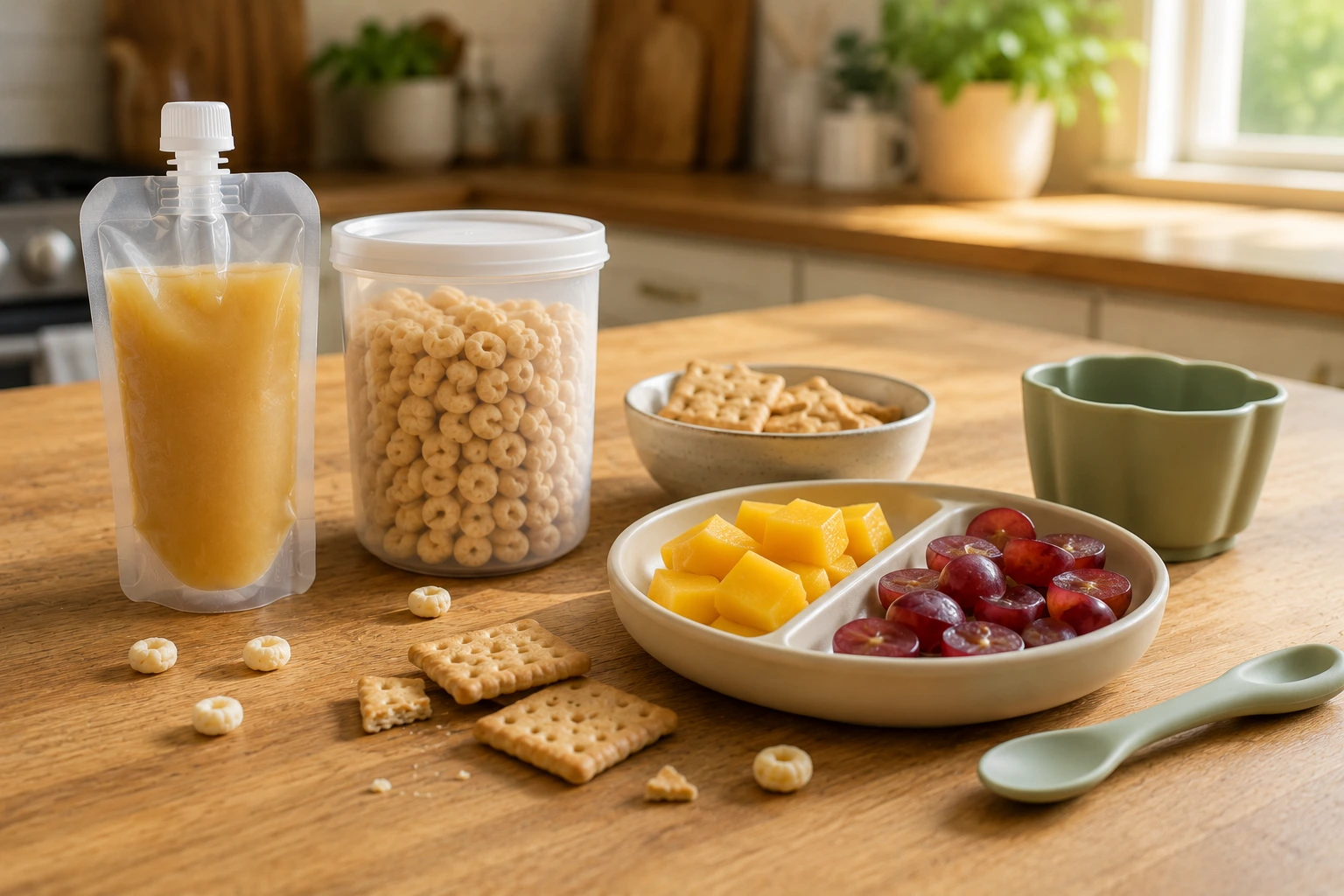
An organic label can still sit on a pouch with juice concentrate near the top of the ingredient list. “Organic” tells you how ingredients were produced; it does not answer the sugar, ingredient-order, or texture question.
That is the screen I used here. USDA labeling rules distinguish “100 percent organic,” “organic” (at least 95% organic ingredients, excluding salt and water), and “made with organic” (at least 70%). Then the nutrition panel and ingredient list answer different questions: added sugars, what dominates the recipe by weight, and whether the format makes sense for the child’s developmental stage. Organic is a production standard, not a full nutrition verdict.
I compared the products below using those criteria plus package format, price/value, manufacturer age guidance, and practical limitations. Here is what survived the screen — and exactly why each product did or did not make the cut. For a broader look at what to put alongside these snacks in the lunchbox, the healthy lunchbox guide covers the full picture.
This post contains affiliate links, including Amazon links. As an Amazon Associate, I earn from qualifying purchases at no extra cost to you. I only recommend products after reviewing the label, format, and trade-offs I can actually support; this is not a claim of personal child testing. Affiliate Disclosure.
- Want the strongest all-around pouch by this screen? Happy Baby Clearly Crafted is it.
- Need more protein in the mix? Serenity Kids is the only pouch here that delivers it.
- Starting finger foods? Happy Baby Organic Puffs is one packaged option to compare once the child is developmentally ready for its texture and can eat seated with supervision.
- Want a cracker-style option? Annie’s Cheddar Bunnies can be considered only when the child can safely manage that texture; molar timing alone is not the readiness test.
- Considering a chewier fruit snack? Solely Organic Fruit Jerky is single-ingredient, but its chewy texture makes age/readiness and choking risk part of the decision rather than a blanket “Readiness-dependent” rule.
In This Guide
- What Actually Makes a Toddler Snack Clean
- Best Organic Pouches
- Best Puffs and Crackers
- Best Fruit Snacks for Older Toddlers
- What to Skip
- Buying Smarter: Thrive Market
- All 5 at a Glance
- Find the Right Snack
- FAQ
What Actually Makes a Toddler Snack Clean
Most of what gets sold as a healthy toddler snack passes the organic test and fails the ingredient test. Three things on the label tell you most of what you need to know:
1. The certification tier. Under USDA organic labeling rules, products labeled “organic” contain at least 95% certified organic ingredients (excluding salt and water), while “made with organic” products contain at least 70%. That is a production-standard distinction — not a promise about added sugar, texture, or overall nutritional quality.
2. Added sugars on the nutrition label. The updated nutrition label separates “total sugars” from “added sugars” on a distinct line. A pouch with 8g of total sugar entirely from fruit will show 0g added sugars. A pouch sweetened with organic apple juice concentrate will show those grams as added. That added sugars line is the one that matters. The AAP recommends avoiding added sugar for children under 2.
3. Ingredient order. Ingredients are listed by weight, heaviest first. If cane sugar, syrup, or juice concentrate appears near the top, treat that as a reason to check the Added Sugars line rather than letting the organic badge make the nutrition decision for you. I prefer products where a recognizable fruit, vegetable, whole grain, or protein leads the list.
The label will not tell you whether the texture is developmentally appropriate. For babies and toddlers, preparation, shape, size, texture, posture, and supervision all affect choking risk. The CDC recommends matching texture to the child’s development, cutting or mashing foods when needed, keeping children seated, and supervising them while they eat. Variety of texture matters as feeding skills develop, but I would not use a molar calendar or a product’s ability to dissolve as proof that a snack is “safe.”
The organic badge answers a production question; the Added Sugars line answers a different one. If you want that second check in a printable you can use at the store, this is the next step.
Use the 30-Second Sugar Check on Organic Snacks
It includes current label examples, common added-sugar names, practical swaps, and printable fridge-and-shop checklists.
Get the checklist and practical kids’ nutrition tips. Unsubscribe anytime.
Something went wrong. Please check your email address and try again.
Best Organic Pouches
Happy Baby Clearly Crafted Pouches — Best Overall
Ages: 6mo+ | Added sugar: 0g | Cert: USDA Organic | Price: ~$1.80–2.20/pouch retail
The “Clearly Crafted” name is marketing, but the product backs it up. The packaging is transparent so you can see the actual food inside, and the ingredient list matches — fruit, vegetables, and water. USDA Organic certified, not just “made with organic ingredients.”
The pouch format is convenient and the flavor range is broad, but age labels are only a starting point. Use the child’s actual feeding skills and clinician guidance when there are developmental concerns, and keep offering appropriate whole-food textures rather than letting pouches become the only format.
- Clean across all flavor varieties — not just select SKUs
- USDA Organic (95%+ threshold)
- Clear packaging shows actual food content
- Wide flavor range — higher odds of finding one that sticks
- Widely available (Target, Amazon, Whole Foods)
- Carbohydrate-forward — not a meaningful protein source
- Pouch format should not crowd out developmentally appropriate food textures (see FAQ)
- Price adds up with frequent use — compare current per-pouch prices rather than assuming a fixed retailer discount
If I wanted one default fruit-and-vegetable pouch from this group, Happy Baby Clearly Crafted is the one I’d start with — with the usual pouch-format caveats.
Serenity Kids Meat + Veggie Pouches — Best for Protein
Ages: 6mo+ | Added sugar: 0g | Price: ~$3.50–4.50/pouch
Most toddler pouches are fruit and vegetable purees — high in carbohydrates, low in protein and fat. Serenity Kids takes a different approach: their pouches combine a protein source (pasture-raised beef, turkey, chicken, or wild-caught salmon) with a vegetable base. The result is meaningful protein and fat alongside vegetables, with no fruit and no added sugar.
These are more expensive than fruit pouches and the flavors are savory rather than sweet, so acceptance may vary. The useful reason to consider them is nutritional format: they add protein and fat to a category dominated by fruit-and-vegetable purees. That does not make them a substitute for meals or for developmentally appropriate chewing practice.
- Meaningful protein and fat — nutritionally different from fruit pouches
- 0g added sugar
- No fruit base and 0g added sugar on the label used for this comparison
- A pouch option for families specifically looking for more protein and fat than a fruit puree provides
- Significantly more expensive than fruit pouches
- Savory flavor may be less familiar than fruit-forward pouches
- Less widely available — mostly online or Whole Foods
Most pouches are carb-only. Serenity Kids is the one that puts pasture-raised protein in there too.
Best Puffs and Crackers
Happy Baby Organic Puffs — Packaged Finger-Food Option
Age/readiness: Check package guidance + feeding skills | Added sugar: 0g | Cert: USDA Organic | Price: ~$4–5 per container
Happy Baby Organic Puffs soften quickly with moisture and contain 0g added sugar on the label used for this comparison. That can make the texture easier to manage than hard, round, sticky, or chewy snack foods, but quick-softening does not make any food choking-proof. Follow the package age guidance, match the shape and texture to the child’s feeding skills, keep the child seated, and supervise eating.
The honest nutrition note: puffs are not nutritionally dense. Their practical role is a small, quick-softening finger-food format, not delivering meaningful protein, fat, or micronutrients. If the child’s feeding skills and the package guidance fit, they can be one option for self-feeding practice — with the same seated-eating and supervision rules as other foods.
- Softens quickly with moisture; still requires age-appropriate use and supervision
- Right size for developing pincer grasp
- Small, easy-to-portion pieces for self-feeding practice when developmentally appropriate
- Nutritionally minimal — primarily refined starch
- Not a meaningful food serving; purely a texture and motor skill practice tool
- Once toddlers can chew, transition toward more nutritionally useful snacks
Not a nutrient-dense snack — a quick-softening packaged option for self-feeding practice when the texture is developmentally appropriate. Happy Baby Organic Puffs is the one I’d compare here.
Annie’s Cheddar Bunnies — Best Cracker
Age/readiness: Firmer cracker texture; check package + skills | Added sugar: 0g | Cert: USDA Organic | Price: ~$5–6 per box
Annie’s Cheddar Bunnies use organic wheat flour and organic cheddar cheese, and the label used for this comparison shows 0g added sugar. The sodium number is about 150mg per 30-piece serving on that label, so it is still worth reading in the context of the rest of the child’s diet. Nutritionally this is a cracker, not a protein-rich snack; its advantages here are the straightforward label and practical shelf-stable format.
These are a firmer, drier cracker texture than puffs and need more chewing skill. I would not use “back molars are in” as the readiness rule: choking guidance focuses on the child’s developmental ability and on food shape, size, and texture. For younger children, choose foods that are prepared to a texture they can manage safely and supervise eating.
- 0g added sugar, organic wheat and real cheddar
- Widely available everywhere
- Shelf-stable and easy to portion
- Good size and shape for small hands
- Firmer texture requires more chewing skill; readiness is developmental, not a molar-age shortcut
- Moderate sodium — fine in context, worth knowing
- Low in protein and fat; pair with something more substantial at snack time
Annie’s Cheddar Bunnies: the familiar cracker-style option here, with a firmer texture that deserves a real readiness check for younger toddlers.
Best Fruit Snacks for Older Toddlers
Solely Organic Fruit Jerky — Chewy Single-Ingredient Option
Age/readiness: Check package guidance + chewing skill | Added sugar: 0g | Cert: USDA Organic | Price: ~$2.50–3.50 per pack
Solely makes single-ingredient organic fruit jerky — one ingredient, the fruit itself, nothing added. Mango, papaya, and pineapple are common varieties. The texture is genuinely chewy, which is exactly why I would treat it as an older-toddler/child option only when the individual child can manage that texture safely; chewy dried fruit can be a choking concern for young children.
Natural sugar content is higher than puffs — this is dried fruit, so sugars are concentrated — but it’s 0g added sugar, no juice concentrate, no sweeteners, and the sugar comes alongside fiber. Because the texture is chewy and concentrated, I would treat this as a readiness-dependent option rather than attaching a universal age cutoff. If the child cannot manage chewy dried fruit safely, skip it.
- Single ingredient — the cleanest possible label
- 0g added sugar
- Chewy texture offers a very different sensory format from puffs and crackers
- Fiber alongside the natural sugars
- Not a fit for children who cannot manage chewy dried fruit safely
- Higher natural sugar than other snacks on this list (it’s concentrated fruit)
- Less available in stores — mostly Amazon or Thrive Market
Solely Organic Fruit Jerky is the only snack on this list I’d actually call dessert-adjacent — and it’s still just fruit.
What to Skip
If you’re looking specifically for little or no added sugar, start with the Added Sugars line rather than trying to judge the package from the front. Organic products can still use cane sugar, syrups, or juice concentrates as sweeteners, so the certification and the nutrition panel need to answer separate questions. A few patterns are worth checking product by product:
Juice concentrate used as a sweetener. Apple, white-grape, and pear juice concentrates can appear in organic pouches and bars. When concentrate is being used to sweeten a product, the Added Sugars line is the clearer shortcut than trying to infer the nutrition impact from the ingredient name alone.
Organic bars and cookies with refined flour plus added sweeteners near the top. The organic certification can be completely legitimate while the product still functions more like a sweet snack. Compare the first ingredients and the current Added Sugars number instead of treating the category name as a verdict.
“Organic natural flavors” as a catch-all in an otherwise questionable list. One instance of “organic natural flavors” in a short, clean ingredient list isn’t a deal-breaker. In a snack where it appears alongside multiple sweeteners or fillers, it’s worth reading the full list carefully rather than relying on the organic claim on the front.
Yogurt melts with added sweeteners. Some formulas use cane sugar, tapioca syrup, or other sweeteners and can carry a meaningful amount of added sugar for a small snack. Formulas vary, so check the current package rather than assuming the word “yogurt” or the organic seal makes the sugar question disappear.
Soft-baked oat bars and toddler granola bars. Some versions lead with whole grains or fruit; others pair refined flour with added sweeteners. There is no magic 2g cutoff that turns a bar into a “clean” food. Compare the ingredient order, Added Sugars line, serving size, and how the bar fits the rest of the snack.
Buying Smarter: Thrive Market
Thrive Market carries several brands in this category, but membership pricing and product discounts change. I would not assume a fixed 25–35% savings rate or claim that the membership automatically pays for itself from toddler snacks alone.
If you are considering it, compare the current membership cost and the exact products you buy most often against your usual retailer. The separate Thrive Market review is the better place for current membership math.
All 5 at a Glance
Every organic toddler snack from this review in one place — use case, age, added sugar, and price side by side.
| Snack | Best for | Ages | Added sugar | Price (approx.) |
|---|---|---|---|---|
| Happy Baby Clearly Crafted pouches | Fruit + veg intake, all-around best pouch | 6mo+ | 0g | ~$1.80–2.20/pouch |
| Serenity Kids meat + veg pouches | Protein intake, alternative to fruit pouches | 6mo+ | 0g | ~$3.50–4.50/pouch |
| Happy Baby Organic Puffs | Quick-softening packaged finger-food option | Check package + readiness | 0g | ~$4–5/container |
| Annie’s Cheddar Bunnies | Firmer cracker option | Readiness-dependent | 0g | ~$5–6/box |
| Solely Organic Fruit Jerky | Chewier dried-fruit option | Readiness-dependent | 0g | ~$2.50–3.50/pack |
Find the Right Snack
Two questions, one recommendation.
Answer both questions above to get your personalized snack recommendation.
Best Organic Snacks for Toddlers FAQ
Pouches are a food format, not a diagnosis. The practical concern is over-reliance on one very smooth texture when a child also needs chances to practice developmentally appropriate chewing and self-feeding. Offer a variety of safe textures as skills develop. If a child has persistent texture refusal, coughing, choking, or feeding-skill concerns, bring that to the pediatrician rather than trying to solve it with a snack list. The picky eater lunch ideas guide covers low-pressure food exposure for older children, but feeding-skill problems need individualized advice.
USDA Organic means at least 95% of the ingredients are certified organic. “Made with organic ingredients” means at least 70% — the remaining ingredients must still follow the rules for that labeling category, but the organic share is lower. If maximizing the proportion of certified-organic ingredients is your priority, the 95% threshold is the clearer fit. If you’re mainly judging sugar or ingredient simplicity, the certification tier cannot answer that question by itself — read the current nutrition panel and ingredient list.
Many toddlers do well with a predictable rhythm of meals and snacks, but the exact number and timing vary with age, appetite, childcare schedule, growth, and medical needs. The useful principle is structure rather than a universal clock: offer food at reasonably predictable times and avoid letting snacks crowd out meals. When you want a more specific feeding schedule for your child, use guidance from their pediatrician or dietitian.
There is no single packaged “best” first finger food. At this age, prioritize foods prepared to the right shape, size, and texture for the child’s current skills, with the child seated and supervised. Soft whole foods can work well; a quick-softening puff is one packaged option if the label age guidance fits. The CDC specifically warns that choking risk depends on preparation and developmental readiness, so I would not use back-molar timing as the decision rule.
Maybe, but do the current math instead of assuming a standard savings percentage. Compare today’s membership cost and the exact products you reorder against your usual retailer. If the price gap on your real basket is small, the convenience may be the main benefit; if it is large and you order often, membership can make more sense. I keep the changing membership details in the Thrive Market review.
Final Thoughts
The organic label answers how the agricultural ingredients were produced. It does not by itself answer the added-sugar, ingredient-order, price, texture, or developmental-readiness questions — those are the gaps every product on this list was screened against.
Within this shortlist, the practical breakdown is by format and readiness: Happy Baby Clearly Crafted as a convenient pouch option, Organic Puffs as a quick-softening packaged finger-food option when developmentally appropriate, Annie’s Bunnies for children who can safely manage the firmer cracker texture, and Solely Organic Fruit Jerky only when the chewy format is appropriate for the individual child. If you’re specifically looking for more protein and fat in a pouch, Serenity Kids is the distinct option in this group.
These snacks are one piece of the picture — for the bigger view on building full toddler meals and lunches around them, the healthy lunchbox guide is the place to start. For ideas on what to put alongside these snacks in a packed lunch, the kids lunch box guide covers which containers actually keep snacks separated and which work best by age.
And for a broader range of toddler snack ideas organized by age, school snack ideas for kids has the full age-by-age breakdown.
Nothing in this post is medical or nutritional advice. I research labels, product formats, and pediatric guidance, but I’m not a pediatric dietitian or healthcare professional. Talk to your child’s pediatrician if you have specific concerns about diet, allergies, chewing/swallowing skills, choking risk, or developmental feeding milestones.