
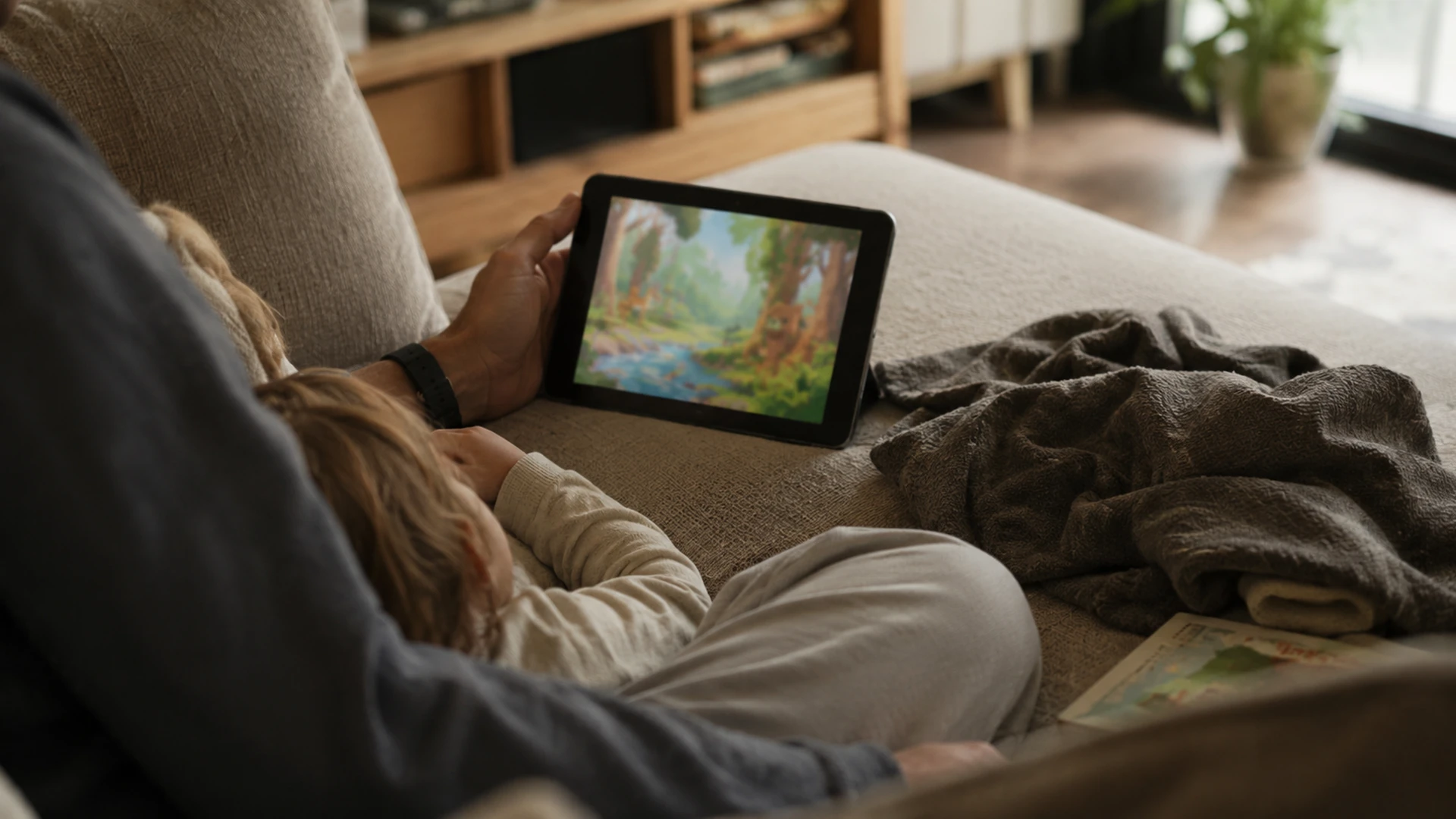
“Two hours a day” is the screen time rule almost every parent has heard — and it’s the number most likely to generate exactly the wrong kind of conflict: rigid minute-counting, negotiations over the last five minutes, meltdowns at screen-off time. A strict hour cap, applied the same way at every age, tends to create more friction than the screens themselves cause.
Part of the problem is that the number itself is wrong for most of the ages parents apply it to. The AAP’s actual limit for a preschooler isn’t two hours, it’s one. The “two hours” figure so many parents repeat isn’t really current AAP guidance at all; it’s a leftover from older recommendations that have since been replaced, and even at the time, duration was never the most important part of the guidance. The research behind it is about far more than a single number. When you actually look at what the studies show, the timing and type of screen use matter at least as much as total hours — and for school-age children, the guidelines themselves have moved away from strict hour caps toward something more contextual.
This post contains one affiliate link. As an Amazon Associate, I earn from qualifying purchases at no extra cost to you. I only recommend products backed by careful research and comparison. See my full affiliate disclosure.
Table of Contents
- What the AAP Screen Time Guidelines Actually Say
- Screen Time Guidelines by Age: The Full Breakdown
- What the Research Shows
- Why Timing Matters as Much as Duration
- Not All Screen Time Is Equal
- How to Set Screen Time Limits That Actually Hold
- Find Your Starting Screen Time Rule (2-Minute Tool)
- FAQ
- Final Thoughts
- Under 18 months: no screens except video chat
- 18 months–5 years: high-quality, co-viewed content; 1-hour daily cap for ages 2–5
- Ages 6 and up: no specific hour cap — consistent limits based on what screens are displacing
- Where the research is most concerned: sleep displacement, passive consumption in very young children, and social media for tweens and teens
What the AAP Screen Time Guidelines Actually Say
The question most parents start with is: how much screen time for kids is actually appropriate? For AAP screen time guidelines specifically, the answer depends on your child’s age — and for school-age children, the current guidance is more contextual than most people expect.
The American Academy of Pediatrics — the largest pediatric professional association in the United States, representing more than 67,000 pediatricians — issued its foundational age-based framework in 2016 and has updated it significantly since, with social media guidance in 2023 and 2024 and a broader Digital Ecosystems policy statement in early 2026. It’s worth being precise about the timeline here: the shift away from a fixed hour cap for school-age children isn’t new in 2026 — it’s been the AAP’s position since that 2016 framework, which replaced the older blanket two-hour rule with a contextual, displacement-based approach for kids six and up. What the 2026 statement adds is a broader lens: it extends that same contextual logic beyond “screen time” to the whole digital ecosystem a child moves through — platform design, algorithmic feeds, and AI tools, not just hours on a device.
Here’s how that guidance breaks down by age:
| Age Group | AAP Guidance | Key Principle | Biggest Risk |
|---|---|---|---|
| Under 18 months | Avoid screen media except video chatting | Language and social development require in-person interaction this age can’t get from screens | Reduced caregiver talk when background screens are on |
| 18–24 months | High-quality programming only; watch together with your child | Toddlers this age learn from screens primarily through co-viewing with a caregiver | Video deficit effect — limited real-world learning transfer |
| Ages 2–5 | Limit to 1 hour per day of high-quality programming | Quality and co-viewing matter as much as duration; slow-paced, interactive content differs meaningfully from passive entertainment | Passive, low-quality solo viewing crowding out interactive play |
| Ages 6 and up | Consistent limits; screens shouldn’t displace sleep, physical activity, homework, or face-to-face interaction | Context and displacement matter more than total hours for this age group | Sleep displacement, especially screens in the hour before bed |
| Reflects AAP guidance current as of mid-2026, including the Digital Ecosystems policy statement and 2023–2024 social media updates. | |||
The shift in guidance for older children reflects what the research actually shows: there’s no strong evidence that recreational screen time in reasonable amounts harms school-age children, as long as it doesn’t displace activities that are developmentally important. The current recommendation for kids six and older doesn’t name an hour limit — it asks parents to ensure screens aren’t crowding out sleep, movement, homework, and face-to-face time.
That’s a meaningful distinction from how screen time guidelines are usually communicated. Most of the “two hours for all ages” advice circulating online is outdated or misapplied — it reflects earlier guidance that has since been updated, specifically for school-age children. The one-hour limit is for ages 2–5. It was never meant to apply to a healthy, active ten-year-old who’s sleeping well.
Screen Time Guidelines by Age: The Full Breakdown
Under 18 Months: Why the AAP Says Avoid Screens
The evidence against passive screen time in this age range is the strongest of any group. Infants under 18 months are in a critical period for language acquisition, and the mechanism by which they acquire language — responsive, contingent, back-and-forth interaction — is fundamentally different from what a screen can provide. A screen talks at an infant; it can’t respond to them in real time based on what they do or say.
Research consistently shows that background TV, even when parents aren’t watching it, disrupts the quality of caregiver-infant interaction. Adults talk to infants less when a TV is on, often unintentionally. Quantity and diversity of language input at this age predicts vocabulary development — so even ambient background noise from a screen creates measurable displacement of the interactions that matter most.
The AAP’s exception for video chatting — FaceTime, Zoom calls with grandparents — is grounded in the value of real-time two-way interaction. A grandparent can respond to what the baby does in a way a passive video cannot.
Ages 18–24 Months: The Video Deficit Effect
This is the window where limited screen media can be introduced if parents choose to, but the “choose high-quality and watch together” guidance is doing significant work. Developmental research summarized in the AAP’s Media and Young Minds guidance shows that toddlers this age have real difficulty applying what they see on a screen to the real world — a phenomenon called the video deficit effect. They generally learn less from a video demonstration of a skill than from the same demonstration in person.
Co-viewing — watching alongside the child, pointing things out, asking questions, and connecting the screen to real objects — helps narrow this learning gap. Programming matters too: young children generally follow slow-paced content with a clear story more easily than rapid, algorithmically served clips.
Ages 2–5: Screen Time for Toddlers and Preschoolers
Ages 2–5 are where the AAP’s 1-hour guideline applies, but quality and co-viewing still matter. An hour of slow-paced content watched with a parent is not the same experience as an hour of solo autoplay video, even though both count toward the limit.
For parents navigating this age, the more practically useful question is often not “how many minutes?” but “what kind of content, and are we watching together?” A 45-minute episode of PBS Kids watched with a parent who talks through what’s happening is likely better developmentally than 30 minutes of algorithmically served short videos watched alone — even though 30 minutes is technically within the limit and 45 isn’t.
The AAP’s emphasis on quality isn’t only about content being narrowly “educational.” It’s about pacing (slower is better for this age), interactivity (content that invites questions and responses rather than passive watching), and the social context of how viewing happens. These three factors predict learning outcomes from screen time in this age group more reliably than total minutes.
Ages 6 and Up: From Hour Caps to Displacement
The shift at age 6 is the one that surprises most parents. For school-age children, the AAP moved away from an hour cap entirely and toward a displacement framework: does screen time come at the expense of sleep, physical activity, homework, or face-to-face social interaction? If not, the research doesn’t support strict hour-based limits as developmentally necessary for this age group.
This is where many parents feel let down by the guidelines — they expected a specific number and got a principle instead. But the principle reflects the actual research, which shows that moderate recreational screen use in school-age children who are sleeping well, physically active, and socially connected isn’t consistently associated with the negative outcomes that dominate the media coverage of this topic.
What the Research Shows
The research on screen time and child development is more complicated than either “screens are harmful” or “it depends.” Some findings are strong and consistent. Others are weaker or mixed. Knowing which is which changes what you should actually be worried about — and what you probably don’t need to be.
Sleep Disruption: The Strongest Finding
Research reviews consistently associate screen use near bedtime with later sleep onset, shorter sleep duration, and poorer sleep quality in children and adolescents. Several mechanisms may contribute, including time displacement, stimulating content, and evening light exposure. The strength of the relationship varies by age, device, content, and how the screen is used, so this is better understood as a consistent risk pattern than a guaranteed effect in every child.
Language Development in Infants and Toddlers
The evidence that passive screen time displaces language-rich interaction in children under two is solid and well-replicated. The video deficit effect is documented across multiple independent research groups. This is why the AAP guidance is most conservative for the youngest children — the developmental stakes of reduced language input at this age are significant, and the mechanism of impact is the clearest of any finding in this literature.
The evidence is less consistent once you move past these younger age groups.
Where the Evidence Is Weaker
For school-age children, associations between recreational screen time and outcomes like academic performance, social development, or mental health are much weaker and more contested than headlines suggest. Studies find small associations, but those associations are frequently explained by other variables — most commonly, sleep displacement. When children sleep adequately and are physically active, the relationship between recreational screen time and outcomes often weakens substantially or disappears in the data.
Gaming and Attention
Parents frequently ask whether video games are more harmful than other screen time. The research doesn’t support treating games as a uniquely harmful category. Some research suggests high-paced, fast-switching games may temporarily affect sustained attention in young children — but this hasn’t translated into consistent findings of long-term harm in school-age children who play in moderation. Strategy and creative building games have different cognitive profiles than reflex-based arcade games. The evidence that gaming displaces beneficial activities is more consistent than the evidence that gaming itself causes harm.
Social Media: A Different Risk Profile
The research on social media — especially for adolescents — shows more consistent associations with anxiety, depression, and body image concerns, particularly for girls. The AAP’s 2023 guidance on social media was not an update to general screen time guidelines; it was a recognition that social platforms constitute a distinct risk category. The mechanisms (social comparison, algorithmic amplification of negative content, around-the-clock social availability) don’t have parallels in games or video content for younger children.
One honest limitation worth naming: most screen time research is observational, not experimental — it shows associations, not causes. It can’t easily distinguish between content types or quality levels, and it runs behind the technology by several years. We don’t have long-term developmental data on current platforms and content formats. This is part of why I hold specific numbers loosely, and why the AAP shifted toward displacement principles rather than hard hour limits for older children.
Why Timing Matters as Much as Duration
If a family kept only one screen rule, this is the one worth keeping: no screens in the hour before bed, and all devices charge outside the bedroom at night. It protects the area where the evidence is clearest without requiring anyone to count every minute of the day.
Children who use screens near bedtime tend to fall asleep later and sleep less, although the size of the difference varies substantially across studies and children. Even a modest recurring sleep loss can compound across a school week. The behavioral consequences of chronic mild sleep deprivation in children — irritability, impaired concentration, and emotional dysregulation — can appear before parents recognize sleep as the cause.
How much sleep children actually need changes by age and is a separate question from screen time. If you’re trying to evaluate whether screens are affecting your child’s sleep, having a clear sense of the target matters — the sleep needs by age guide covers the research-based recommendations from infancy through adolescence. For families already dealing with sleep disruption, what the research shows about magnesium and children’s sleep covers where the supplement evidence is solid and where it has limitations.
Timing matters across the rest of the day too. An hour during genuine free time is different from an hour that replaces sleep, a family meal, homework, or outdoor play. For older children, that question — what is this replacing right now? — is usually more useful than the clock alone.
If the argument at screen-off time starts because “five more minutes” is hard to feel, a visual countdown timer can help make the ending visible instead of turning a parent into the human clock. It doesn’t solve the screen-time decision itself — it just makes the transition less abstract, which is often where the actual conflict lives.
Time Timer MOD Home Edition — silent 60-minute visual countdown, no loud ticking, makes “how much time is left” visible instead of argued about.
Not All Screen Time Is Equal
“Screen time” lumps together activities that ask very different things of a child. A video call, a co-viewed preschool program, a game, and a social feed should not be treated as one experience.
Video Chatting with Family
Video chatting preserves the two-way social interaction that drives language and social development, especially in young children. This is the one category where the evidence of harm is weakest and the evidence of benefit — maintaining relationships with extended family, meaningful interaction with grandparents — is most consistent. The AAP carved video chatting out of its under-18-month restriction explicitly, and research supports that distinction.
Educational Content, Co-Viewed
Educational content for ages 2 and up has demonstrated learning benefits when content is age-appropriate and viewing is interactive. Programs specifically designed for young children — Sesame Street, Daniel Tiger, Blue’s Clues — document real gains in vocabulary, letters, and social-emotional understanding in children who watch with a caregiver who extends the learning with conversation. Thirty minutes of this is different from 30 minutes of autoplay YouTube, even if both count toward the same daily total.
Social Media: A Separate Category
Social media occupies a different risk profile entirely for adolescents. It’s not simply about time — it’s about the specific mechanics of these platforms (social comparison, the feedback loop of likes and comments, the algorithmic amplification of emotionally charged content, 24-hour social availability) that don’t have parallels in other screen categories. The AAP suggests waiting until at least age 13 for social media — readiness varies by child — with thoughtful, supervised introduction after that: guidance that is categorically separate from the general screen time framework.
Recreational Screen Time
Recreational screen time — games, entertainment videos, streaming — is the category where the research evidence of harm in school-age children is weakest. The primary risk is displacement of beneficial activities, not the screen exposure itself. Time limits matter here not because the content is uniquely harmful but because children don’t naturally self-regulate screen time, and passive consumption extends easily without structured stopping points.
Background TV
Background TV often goes uncounted in screen time tallies but has documented effects worth knowing about. A television on in a common room while children play nearby — even when no one is actively watching — reduces the quantity and complexity of parent-child verbal interaction. It also disrupts children’s play concentration, shortening play episodes and reducing play complexity. Many families who feel confident about their screen time limits are running background TV for several hours a day. This is worth examining as its own variable, separate from intentional screen use.
- What are they watching? Slow-paced, interactive, or educational content offers something different from fast-paced entertainment or algorithmically served short-form video. The type affects what, if anything, is being displaced or gained.
- Who are they watching with? Co-viewing with a caregiver who talks through what’s happening is developmentally different from solo passive watching — especially for children under 5. The social context changes what the child takes away from the experience.
- What is this replacing? Screen time that fills a free period where boredom or outdoor play would otherwise have occurred has a different profile than screen time that pushes out sleep, a family meal, or physical activity. This is the core of the AAP’s displacement framework for school-age children.
How to Set Screen Time Limits That Actually Hold
The screen time rules that actually hold up share a specific set of structural features — ones that make limits predictable rather than something children need to test every day, instead of a strict hour count that invites negotiation.
These roughly build on each other — start with how you name the limit, then layer structure around it.
Name the limit before it becomes relevant. Telling a child that screen time ends in two hours, at the beginning of screen time, works better than announcing a time limit at the one-hour mark. Children process expected transitions better than surprise ones. A one-minute warning before the actual stop matters too. What doesn’t work: the surprise shutdown after an unspecified amount of time that felt like it was still going.
Tie screen time to the schedule, not to the clock. “Screens off after dinner, before bath” is more sustainable than “screens off at 7:15” for most elementary-age children. Schedule-based limits don’t require negotiating whether it’s technically still 7:14. They also don’t require children to understand elapsed time, which matters for preschoolers. The structure that works best varies by age and child, but the principle is the same: limits that connect to a routine don’t need enforcement the same way clock-based limits do.
Make the off-ramp explicit. The hardest part of screen time transitions is usually the return to unstructured time, not the device itself. Children who have a clear, named activity that comes after screen time transition out more smoothly than those who are simply told the screen is off with nothing specified next. A snack, outdoor time, a specific game, or even “you can read until dinner” qualifies. Being explicit about what happens next removes the dead-air problem that makes screen-off feel like a punishment rather than a transition.
Device-free zones and times are more sustainable than per-session limits. No devices in bedrooms at night, no phones at the dinner table, screens off during the first 30 minutes of the morning — location-based and time-of-day-based limits are simpler to maintain because they don’t require tracking minutes or negotiating per use. The AAP specifically recommends no devices in bedrooms at night and device-free family meals because these structural limits connect to real outcomes (sleep and family connection) without requiring ongoing enforcement of hour counts.
Give older children agency within structure. For kids 8 and up, limits they’ve had some input into hold better than limits imposed without conversation. “You have an hour — do you want to use it before or after homework?” gives them control over when without giving them control over how much. Having the conversation about why the limit exists — as a shared acknowledgment that we all manage screens better with structure, including adults — changes the limit from an arbitrary rule to a household agreement.
Find Your Starting Screen Time Rule (2-Minute Tool)
Answer one or two quick questions, depending on your child’s age, to find a practical starting point for your family’s biggest challenge right now.
Frequently Asked Questions
Final Thoughts
The useful takeaway isn’t a perfect daily minute count. For children under 5, age, content quality, and co-viewing still matter. For older kids, protect sleep and notice what media is crowding out. Treat social media as its own readiness conversation rather than just another block of screen time.
At home, the limits most likely to last are simple and predictable: devices charge outside bedrooms, screens end before bedtime, and everyone knows what comes next. Start with one rule your family can actually keep, then adjust based on sleep, mood, school, and connection — not guilt.
Nothing in this post constitutes medical advice. If you have concerns about your child’s development, attention, behavior, or relationship with technology, talk with their pediatrician or a child development specialist.