
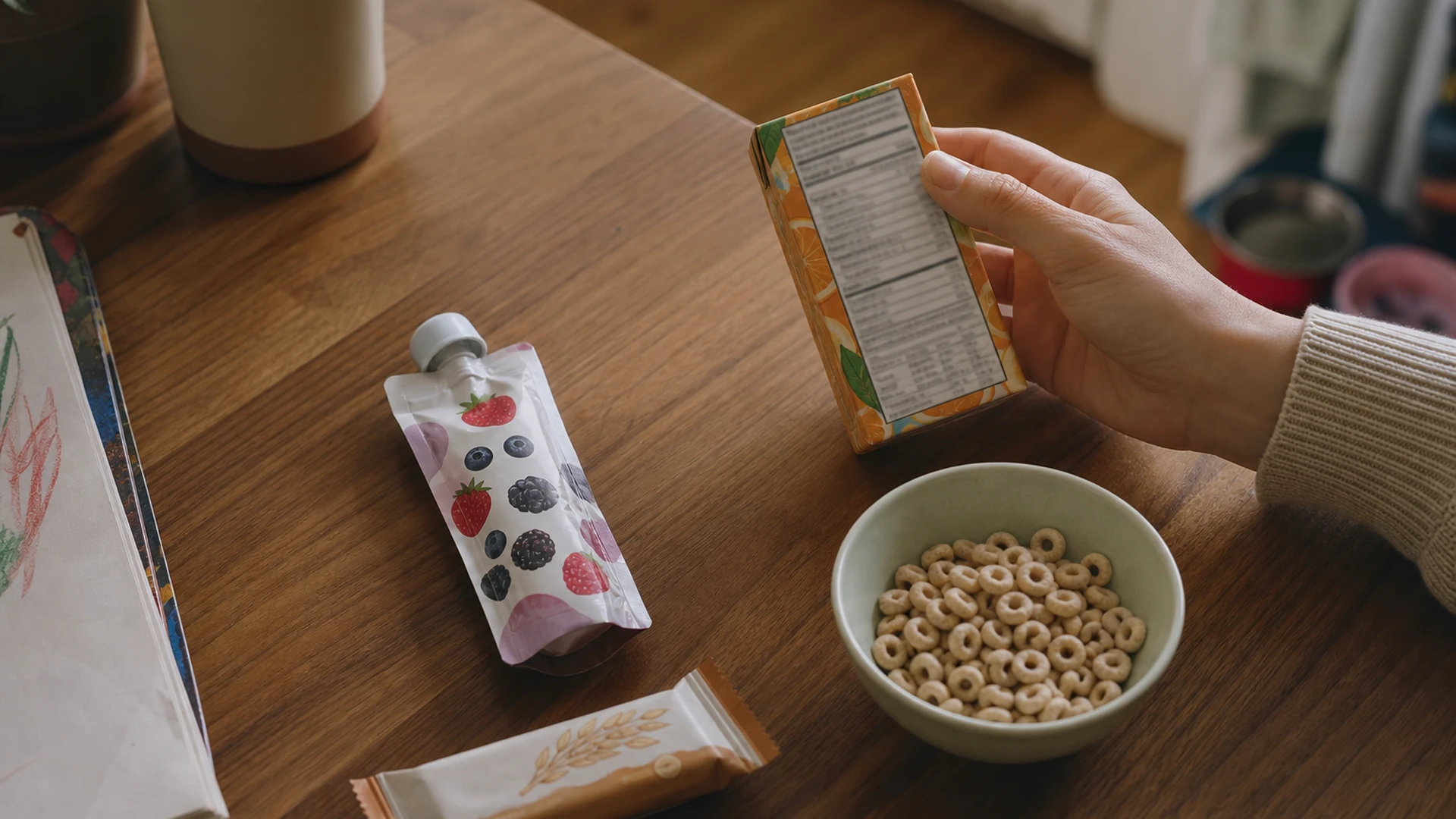
A kids’ yogurt tube can carry 9 grams of added sugar. Two tubes: 18 grams — before you count the rest of the day. That was the kind of label math that made the hidden-sugar problem click for me.
Two tubes is 18 grams — 72% of the American Heart Association’s 25g daily added-sugar ceiling for ages 2–18. Once I started comparing common granola bars, juice boxes, yogurt tubes, and oatmeal packets, the same pattern kept showing up. This post is what I found when I started looking for hidden sugar in kids food: the products that surprised me most, how to spot it on any label in 30 seconds, and the swaps that make the biggest difference.
Table of Contents
- Why “Healthy” Packaging Doesn’t Mean What You Think
- Check Your Child’s Daily Sugar Budget
- The Hidden Sugar in Kids Food That Surprised Me Most
- How to Find Hidden Sugar on a Label in 30 Seconds
- Sugar Names and Hidden Sweeteners to Know
- Simple Swaps That Don’t Require a Pantry Overhaul
- Frequently Asked Questions
- Conclusion
If you’ve ever bought something because it said “organic” or “made with real fruit” and assumed that meant low sugar — this is for you. If you want to see how that 25g benchmark changes by age, my guide to how much sugar kids should have per day breaks down the daily limits.
Why “Healthy” Packaging Doesn’t Mean What You Think
Before I get to the products, I want to say this clearly: if you’ve been buying these foods thinking they were reasonable choices, you were not being careless. The food industry is not lying to you. They’re optimizing for a completely different question than the one you’re asking.
You’re asking: Is this healthy for my kid?
The label is answering: What claim can we legally make that will make you feel good about buying this?
“Organic” means the ingredients were grown without certain pesticides. It says nothing about sugar. “Made with real fruit” means fruit was involved at some point in production; it doesn’t mean the product is low in sugar. “Low fat” often means sugar was added to replace the flavor fat was providing. “No artificial colors” is a statement about dye, not nutrition. None of these claims are false. They’re just answering a different question than you asked.
Once you know that, you stop reading the front of the package and go straight to the nutrition facts panel on the back. The front is marketing. The back is information.
Check Your Child’s Daily Sugar Budget
Enter your child’s age to compare a snack with the AHA daily benchmark and the stricter current federal added-sugar guidance.
My child is:
Start here: choose your child’s age first. Then you can check one familiar snack against the right benchmark.
The Hidden Sugar in Kids Food That Surprised Me Most
Here’s what stood out when I compared common products marketed for kids and products that appear repeatedly in “healthy school lunch” round-ups. I’m using the Added Sugars line from the Nutrition Facts panel — not total sugar, which also includes naturally occurring sugars from fruit and dairy. Added sugar is the number to compare with added-sugar guidance.
The daily limit reference: no more than 25g of added sugar per day for kids ages 2–18, per the American Heart Association. The 2025–2030 Dietary Guidelines are stricter for younger children, recommending no added sugar for children younger than 11 and no more than 10g in a meal for adolescents and adults.
The products below are examples from common kids-food categories and popular “healthy” lunch round-ups. Percentages show how much of the AHA’s 25g daily added-sugar ceiling one labeled serving can use.
| Product | Added Sugar | % of 25g Limit | The Misleading Claim |
|---|---|---|---|
| Chobani Kids Yogurt Tube (flavored) | 8–11g | 32–44% | “Live active cultures,” “real fruit” |
| Yoplait Go-Gurt (1 tube, standard variety) | 8–12g | 32–48% | “Low fat,” fun characters on packaging |
| Honey Nut Cheerios (1 cup) | 12g | 48% | “Heart-healthy oats,” whole grain first ingredient |
| Quaker Dinosaur Eggs Oatmeal (1 packet) | 12g | 48% | “Made with whole grain oats” |
| Clif Kid Z Bar | 10g | 40% | “Organic,” “wholesome snack for kids” |
| Welch’s Fruit Snacks (1 pouch) | 11g | 44% | “Real fruit,” “100% vitamin C” |
| Honest Kids Juice Box | 0g added / ~15g total | — | “Just a tad sweet,” “organic” |
| Mott’s Fruit Snacks (1 pouch) | 13g | 52% | “100% daily vitamin C,” “made with real fruit” |
| Nature Valley Kids Chewy Bar | 7–8g | 28–32% | “Whole grain,” “natural flavors” |
| Stonyfield Organic Kids Pouch (flavored) | 5–9g | 20–36% | “USDA Organic,” “real fruit puree” |
The pattern here isn’t random. The highest-sugar items are almost always the ones marketed as convenient, kid-friendly, and fun. The more a product is designed to be grabbed quickly off a shelf, the more likely sugar is doing the heavy lifting on flavor.
Note: these figures come from labels I checked directly. Formulations change — always verify against the current label before buying.
A note on the juice box: Honest Kids uses fruit juice concentrates, not added sugar, which is why the added sugar line reads 0g. But 15 grams of sugar from concentrated juice still absorbs quickly, without the fiber from whole fruit that would slow it down. The AAP recommends limiting 100% juice to 4–6 oz per day for children ages 4–6, and 8 oz for ages 7–18. One standard juice box puts a young child at or over their daily juice limit.
How to Find Hidden Sugar on a Label in 30 Seconds
This is the part that actually changes what happens at the grocery store. Most parents looking for sugar hiding in everyday kids foods focus on the ingredient list, but the faster move is the Added Sugars line, which has been a required separate entry on all US nutrition labels since 2021. The 56-names-for-sugar list that every article publishes is not what you need in the cereal aisle. What you need is a 30-second habit.
Step 1: Flip the package and go directly to the Nutrition Facts panel. Skip the front entirely.
Step 2: Find the “Added Sugars” line. Since 2021, the FDA requires this as a separate indented line under “Total Sugars.” It looks like this on every label:
That indented line is the one you want. Total sugars includes naturally occurring sugars from fruit and dairy — those aren’t the concern here. Added sugars are what the dietary guidelines refer to.
Step 3: Do the quick math. Divide what you see by 25. A snack with 9g of added sugar is using 36% of your child’s daily budget. If your kid has breakfast, a morning snack, lunch, an afternoon snack, and dinner, those percentages stack fast.
- Ignore the front of the package
- Find “Added Sugars” (indented line under Total Sugars)
- Divide by 25 — that’s the % of the daily budget
- Check the serving size at the top
Step 3.5 — Watch the serving size: Before doing the math, check the serving size listed at the very top of the panel. A product showing 5g of added sugar might use a “serving” of only half a cup — which no child actually eats. Multiply the added sugar by the servings your child realistically eats. This is one of the most common ways label numbers understate actual intake.
Step 4 (optional but revealing): Scan the ingredient list. Ingredients are listed by weight, most to least. If any form of sugar appears in the first three ingredients, that product is built on sweetness. If you see three or four different sugar names distributed across the list, the manufacturer may be splitting them specifically to keep any single one from ranking too high.
That’s the whole method. Flip. Find added sugars. Divide by 25. Decide.
You do not need to memorize those steps in the aisle. I put the same label check into a printable you can use with the package in your hand.
Get the Hidden Sugar Checklist for the Grocery Aisle
Inside: the 30-second label check, current label examples, common added-sugar names, practical swaps, and fridge-and-shop checklists.
Get the checklist and practical kids’ nutrition tips. Unsubscribe anytime.
Something went wrong. Please check your email address and try again.
Sugar Names and Hidden Sweeteners to Know
I said you don’t need all 56 names for daily shopping, and you don’t. The most common hidden sugar food sources for kids fall into four categories — recognizing them by group is faster than memorizing individual names, and it’s useful for the ingredient list check. Here’s a grouped version covering what actually shows up in US kids foods.
Syrups: Corn syrup, high-fructose corn syrup, brown rice syrup, tapioca syrup, agave syrup, maple syrup, cane syrup. “Brown rice syrup” and “tapioca syrup” appear frequently in products marketed as natural or organic. They’re still added sugar.
“-ose” sugars and maltodextrin: These are the ones that trip people up in the cereal aisle. They sound scientific rather than sweet. Glucose, fructose, sucrose, dextrose, maltose, galactose. The “-ose” ending is the chemical signature of a sugar molecule. Lactose, naturally present in dairy, is the exception. Maltodextrin is worth adding to this list — it’s a starch derivative that behaves like sugar in the body and appears in many “better-for-you” kids foods. In a processed kids food context, the rest are typically added sweeteners.
Juice concentrates: Fruit juice concentrate, apple juice concentrate, pear juice concentrate, white grape juice concentrate. This is how a product reads 0g “added sugar” on the label while still delivering significant sweetness: the fruit has been concentrated and its fiber removed.
Everything else: Honey, molasses, coconut sugar, date sugar, cane sugar, turbinado sugar, evaporated cane juice. Often marketed as healthier alternatives. They’re counted as added sugars on nutrition labels and treated the same way by the body.
Simple Swaps That Don’t Require a Pantry Overhaul
I’m not saying throw everything out or ban juice forever. I’m saying that once you know which products are using the most of the daily sugar budget, a few targeted swaps add up without a war at the dinner table.
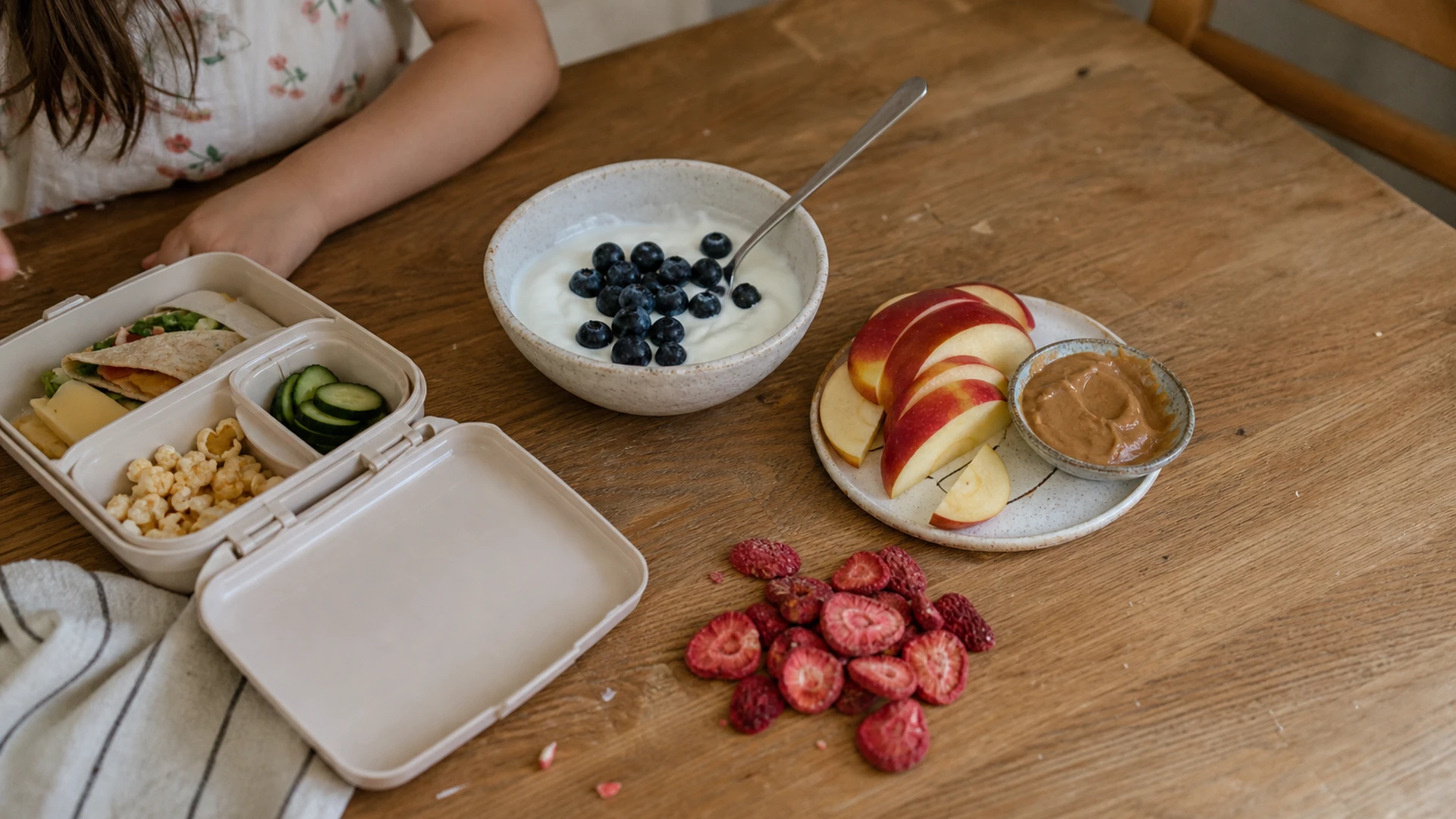
Yogurt: Sugar in kids yogurt is one of the easiest categories to underestimate because naturally occurring milk sugar and added sugar sit next to each other on the label. Plain Greek yogurt with fresh fruit or a measured drizzle of honey can contain far less added sugar than many flavored tubes and pouches while providing more protein. Lower-sugar flavored options can also make the transition less abrupt. If you’re building a lower-sugar snack routine, see my guide on best sugar-free snacks for kids.
Granola and snack bars: Sugar in kids granola bars is one of the more frustrating surprises on labels, because the packaging leans hard on words like wholesome and organic. RXBAR Kids and Larabar Kids are made primarily from dates, nuts, and egg whites. The sweetness is from whole dates rather than added sugar, and the ingredient lists are short. Not the cheapest option, but the formulation is genuinely different from mainstream kids bars.
Cereal: Sugar in kids cereal is sneaky because whole grain and heart-healthy claims dominate the front of the box. Plain Cheerios has 1g of added sugar per serving versus 12g for Honey Nut. Add a drizzle of honey or sliced banana at home; you control the amount. Current labels put plain Kix at 4g added sugar per serving and Barbara’s Original Puffins at about 5g; both still clear the under-6g screening rule used in the cereal guide. For side-by-side label comparisons of common cereal brands, see my guide on best low-sugar breakfast cereal for kids.
Oatmeal: Plain rolled oats with cinnamon and a measured amount of maple syrup let you control the added sugar instead of accepting whatever is pre-loaded into a flavored packet. The format stays familiar; the sugar amount becomes visible.
Juice and fruit snacks: Whole fruit is the obvious swap: same vitamins, with the fiber intact to slow sugar absorption. If juice is a genuine non-negotiable, 4 oz diluted with 4 oz of water cuts the sugar in half while keeping the ritual. For packaged snacks, Bare Snacks baked apple chips and freeze-dried fruit have zero added sugar and are actually shelf-stable. For more on swapping out sugary drinks specifically, see my guide on sugar-free drinks for kids.
Frequently Asked Questions
Conclusion
The yogurt tube, the granola bar, the juice box. None of them come with a warning. Hidden sugar in kids food often sits behind words like “organic,” “real fruit,” and “wholesome.” Spotting it doesn’t require memorizing 56 ingredient names or overhauling the pantry. It requires flipping the package, finding the Added Sugars line, and knowing what the number means. Once you know where to look, the check takes seconds. That’s the 30-second habit worth keeping. If you want to go further than label-reading — an actual system for cutting back across the whole day — my guide on how to reduce sugar in your child’s diet walks through that.
Sources and accuracy note: Sugar gram figures are drawn from publicly available nutrition facts panels; selected cereal figures were rechecked August 2026, while other product examples were last broadly fact-checked March 2026. Always verify against the current label, as formulations change. Added-sugar references include the American Heart Association’s <25g/day ceiling for ages 2–18, AAP guidance to avoid added sugar under age 2 and keep intake low in older children, and the 2025–2030 Dietary Guidelines’ stricter direction for younger children. Nothing in this post is medical advice. I research labels and nutrition guidance carefully, but I’m not a healthcare professional. Always consult your child’s pediatrician before making major dietary changes.