
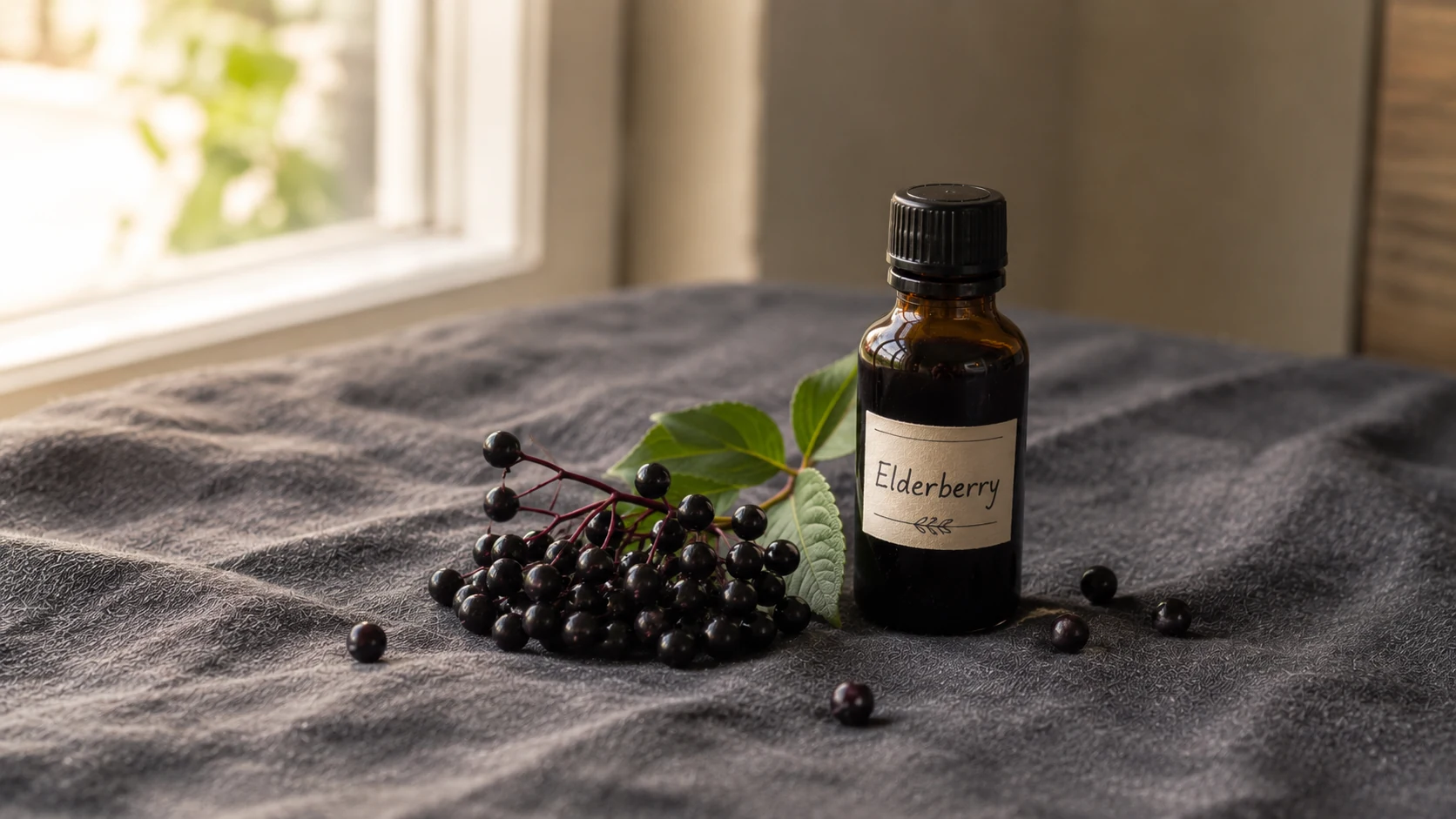
Elderberry is the supplement that shows up at the front of the store every cold season, with confident “supports immune health” language and a reputation that spreads mostly by word of mouth. That kind of momentum is easy to trust without actually checking it.
So I read the actual research, and it’s more complicated than the label suggests. Not alarming — just not as settled as the wellness world tends to present it. There’s real science here, but also real gaps, and the gaps matter when you’re deciding whether to add another supplement to the shelf.
This is what I found about elderberry for kids: what it appears to do, what’s still uncertain, how it stacks up against zinc and vitamin C, and which products come out ahead on label transparency and formulation quality. It’s also one piece of a broader immune support plan — I cover where elderberry fits alongside zinc, vitamin D, and probiotics in a separate guide.
Some links on this page are affiliate links. I only recommend products I’ve researched thoroughly. As an Amazon Associate I earn from qualifying purchases. See my full affiliate disclosure.
Already decided? Jump straight to my picks →
Table of Contents
- Does elderberry work for kids?
- Is it safe for kids?
- Elderberry vs. zinc vs. vitamin C
- Which one fits your situation?
- Elderberry for kids: my picks
- FAQ
Does Elderberry Work for Kids?
The active compounds in elderberry — primarily anthocyanins from Sambucus nigra — appear to interact with viral surface proteins and modulate certain cytokines, the signaling molecules that coordinate immune response. Two reasonably well-designed randomized controlled trials in adults found that elderberry extract taken early in illness shortened cold duration by roughly two days on average. A third study on air travelers found similar results for flu-like symptoms.
The caveat for parents: most of this research is on adults. Pediatric-specific trials are limited, and the adult studies themselves tend to be relatively small — larger, well-powered pediatric trials simply don’t exist yet. We’re largely extrapolating from adult data, which isn’t ideal — but that’s common in pediatric supplement research. The best honest summary: elderberry for kids looks similar to elderberry for adults in terms of mechanism, but the evidence base is thinner on both counts. The NIH’s overview of elderberry research reaches the same cautious read — some preliminary evidence for upper-respiratory symptoms, but nothing conclusive.
The framing that matters throughout this post: research suggests elderberry may reduce the duration of cold symptoms when started early — a real finding, but a modest one, and thinner in pediatric evidence than most labels suggest.
Is Elderberry Safe for Kids?
Most of the elderberry syrup for kids options at pharmacies and health food stores use standardized Sambucus nigra extract — the form the research has actually tested. That matters more than brand name. Here’s what else you should know:
Raw elderberries are not safe. They contain sambunigrin, a cyanogenic glycoside that causes nausea and vomiting. Properly processed commercial preparations use heat-treated, standardized extract — that risk doesn’t carry over. But raw berries or homemade preparations with inadequate cooking are a different story.
The cytokine concern is real but context-dependent. Elderberry stimulates certain pro-inflammatory cytokines including IL-1β and TNF-α — which is part of the mechanism that appears to help during illness. For most healthy kids, this is fine. For kids with autoimmune conditions, stimulating those immune pathways may not be appropriate.
When to avoid elderberry — or check first:
- Under 2 years old (no good clinical data; consult your pediatrician)
- Autoimmune conditions — juvenile arthritis, lupus, IBD, or similar
- Known allergy to elderberry or related plants
- Currently on immunosuppressive medication
Short-term use of elderberry for kids ages 2 and up during illness appears reasonable based on current evidence — outside those edge cases.
Elderberry vs. Zinc vs. Vitamin C
If you already have zinc or vitamin C on the shelf, the real question is where elderberry fits. Here’s the direct comparison:
| Elderberry | Zinc | Vitamin C | |
|---|---|---|---|
| Evidence quality | Moderate (mostly adult RCTs) | Strong (consistent RCTs including pediatric) | Moderate (dose-dependent; better for maintenance) |
| Best use case ⭐ | Early in cold onset (first 24–48 hrs) | Reducing duration when started at first symptoms | Daily maintenance; antioxidant support |
| Safe under 2? | Consult pediatrician | Low-dose drops generally yes | Yes — from food or low-dose supplement |
| Kids forms | Syrup, gummies | Drops, liquid, lozenges | Chewables, gummies, liquid |
| Cost per month | $$–$$$ | $ | $ |
| Combine with others? | Yes — no known interactions | Yes — zinc + elderberry at onset is reasonable | Yes — combine freely |
| My verdict | Good seasonal complement — not my first purchase | Buy first if illness onset is the goal | Best daily baseline — combine freely |
My read: zinc has the strongest evidence for shortening cold duration when started early, including better pediatric-specific data. Vitamin C is most broadly appropriate as a daily baseline. Elderberry vs. zinc comes down to evidence quality — zinc edges it out, but combining both at illness onset is a reasonable approach. If you’d rather cover both in a single product, the Mary Ruth’s gummy below bundles elderberry with zinc and vitamin C — the per-nutrient doses run lower than standalone supplements, but it’s a convenient way to get zinc alongside elderberry at onset. Elderberry vs. vitamin C isn’t really the right question — they serve different purposes and work well together. Elderberry is not a replacement for either, but it’s also not just hype.
Which One Fits Your Situation?
The right supplement depends on where you are in the illness cycle — or whether your child has any conditions that change the calculus. Pick the scenario that fits:
What’s going on with your kid right now?
If the tool pointed you toward a format or situation, the products below map directly to those results — each one shows up in multiple result paths.
Elderberry for Kids: My Top Picks
I compared these products on ingredient transparency, extract standardization, formulation quality, and labeling consistency — no one paid me to include them.
Before you buy, check two things on the label:
- Standardization: “Sambucus nigra” is table stakes, not a quality signal. Look for a disclosed percentage such as “standardized to X% anthocyanins,” or a specific mg amount per serving. Plain “elderberry fruit powder” or “elderberry extract” tells you nothing about active compound levels.
- Ingredient order: If elderberry appears after sugar or corn syrup, you are mostly buying a sweetened beverage with a trace of elderberry in it.
Dosing varies by product, age, and weight, so follow the label for the specific product you choose. Check with your pediatrician first if your child takes medication, has a health condition, or is under 2.
Gaia Kids Black Elderberry Syrup
Gaia uses standardized Sambucus nigra extract, no added sugar, and is one of the more transparent brands on sourcing and extract concentration. Marketed for ages 4+. If you want an elderberry syrup for kids where the label matches what’s actually in the bottle, this is the one I’d start with.
Dial in the exact dose instead of guessing with a spoon. Gaia Kids Black Elderberry Syrup, ages 4+.
Mary Ruth’s Elderberry + Vitamin C + Zinc Gummies
A gummy that combines elderberry with vitamin C and zinc — which aligns with the combination-approach evidence above. Marketed for ages 2+, more affordable than Gaia, and the gummy format is easier for younger kids who won’t take syrup. Worth noting: because it’s a combination product, the individual doses of zinc and vitamin C will be lower than standalone supplements — if your child is sick and you want full therapeutic doses of all three, you may prefer separate products. But as a daily maintenance gummy during cold season, the combination is convenient and genuinely useful.
One gummy covers elderberry, vitamin C, and zinc together. Mary Ruth’s, ages 2+.
Nature’s Way Sambucus for Kids
Nature’s Way Sambucus Kids uses standardized Sambucus nigra extract and is widely available at a lower price point than Gaia — a solid pick if syrup format isn’t a requirement and budget is a factor.
Same standardized extract as Gaia, sitting on the shelf at any pharmacy. Nature’s Way Sambucus Kids, ages 2+.
Frequently Asked Questions
For most healthy children ages 2 and up, standardized Sambucus nigra preparations appear safe for short-term use based on current evidence. Under 2 — check with your pediatrician; there’s no good clinical data for infants. Kids with autoimmune conditions should also check with their specialist first, since elderberry stimulates certain immune pathways that may not be appropriate for all conditions.
Look for products that specify Sambucus nigra extract, are free of unnecessary added sugars, and list a standardized extract percentage on the label. Gaia Kids and Nature’s Way Sambucus Kids both meet those criteria.
Both can contain standardized Sambucus nigra extract — the form is mainly about delivery. Syrups allow more precise dosing, are easier to adjust for younger kids, and let you halve or quarter a dose if needed. Gummies are more appealing to kids who resist syrup, but check the added sugar content; some formulations use significant amounts. For kids under 4 or 5, syrup is usually the more reliable choice.
They work differently. Elderberry vs. vitamin C isn’t really a head-to-head — elderberry appears most effective early in illness (reducing duration), while vitamin C has better evidence for daily maintenance. Vitamin C is significantly less expensive and more broadly studied in children. Combining them is reasonable and they have no known interactions.
Zinc has a stronger and more consistent evidence base for reducing cold duration, including better pediatric-specific data. Elderberry has a plausible mechanism and decent adult evidence but fewer well-designed trials in children. If choosing one for illness onset, zinc edges out elderberry on evidence quality. Starting both early in illness is also a reasonable approach — no known interactions between them.
Short-term daily use during cold season appears safe. Long-term year-round daily use hasn’t been well-studied in children. Most evidence is for short-course use — during illness or brief prevention periods. I’d lean toward seasonal or as-needed use rather than year-round supplementation given the current data.
There are no known direct interactions between elderberry and antibiotics, so it’s not contraindicated in the way some supplements are. That said, when a child is on antibiotics, the gut microbiome takes priority. The more useful question is what to do after the course ends: elderberry can resume, but probiotics (specifically Lactobacillus rhamnosus GG or Saccharomyces boulardii) are the more evidence-backed priority for post-antibiotic recovery. If you’re uncertain, ask your pediatrician — they know your child’s specific situation.
Final Thoughts
Most parents building a cold-season supplement shelf start with whatever has the loudest marketing — which usually means elderberry lands in the cart first. After reading the actual research, I’d reverse the order: zinc has the stronger and more consistent evidence for illness onset, and vitamin C makes the better daily baseline. Elderberry earns its place as a complement — genuinely useful in that first 24–48 hours, ideally alongside zinc. Just not the foundation.
For most healthy kids over 2, the practical question is timing: elderberry is most likely to matter in the first 24–48 hours of illness onset — if it’s on the shelf, that’s when to reach for it. For general immune support the rest of the year, consistent sleep, a decent diet, and vitamin D do more consistent work, backed by stronger and broader pediatric evidence.
If you’re trying to build an evidence-based supplement plan rather than adding products one at a time, my guide to natural ways to support your kid’s immune system covers each of those areas together — sleep, vitamin D, zinc, probiotics, and elderberry, with the same kind of evidence review for each. And if antibiotics are in the picture, my kids’ probiotic breakdown is the most useful next read.